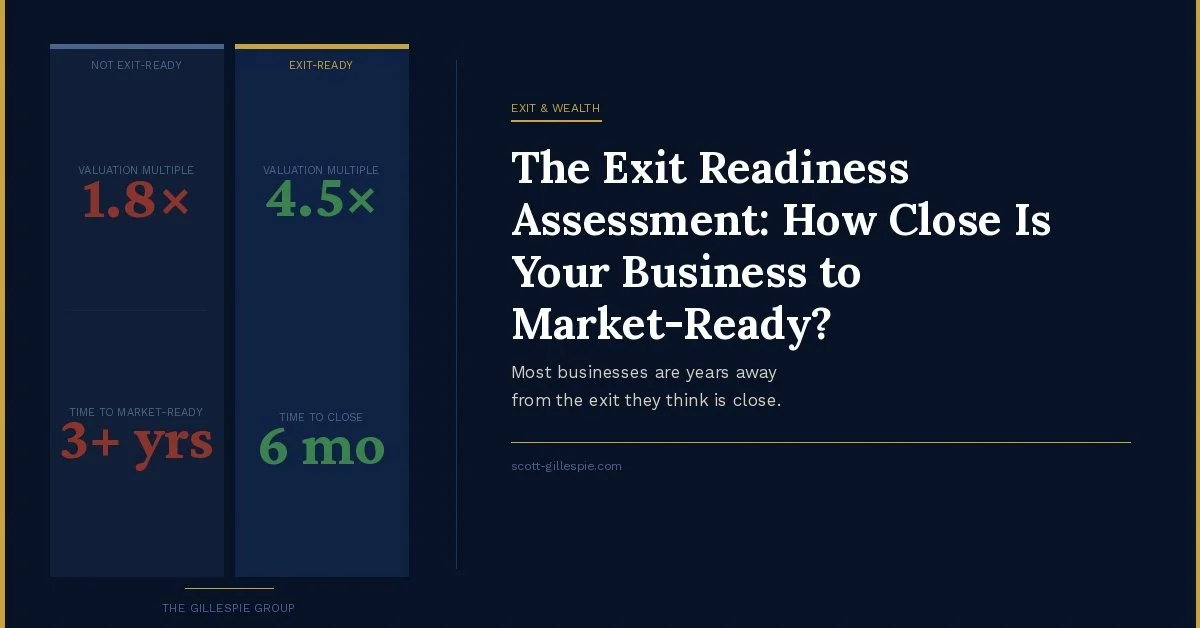
The Exit Readiness Assessment: How Close Is Your Business to Market-Ready?
You currently possess a number in your head that represents the value of your life’s work. You arrived at this figure by looking at your top-line revenue, glancing at your bank balance, and adding a healthy dose of emotional sweat equity. You believe that when the time comes to walk away, a buyer will see the same value you see. This assumption is the most dangerous financial gamble you can make. The market does not care about your history, your late nights, or your personal attachment to the brand. The market only cares about risk. Most small businesses under $10 million in revenue fail to sell not because they lack revenue, but because they lack readiness. You might feel ready to leave, but your business is likely unready to be owned by someone else.
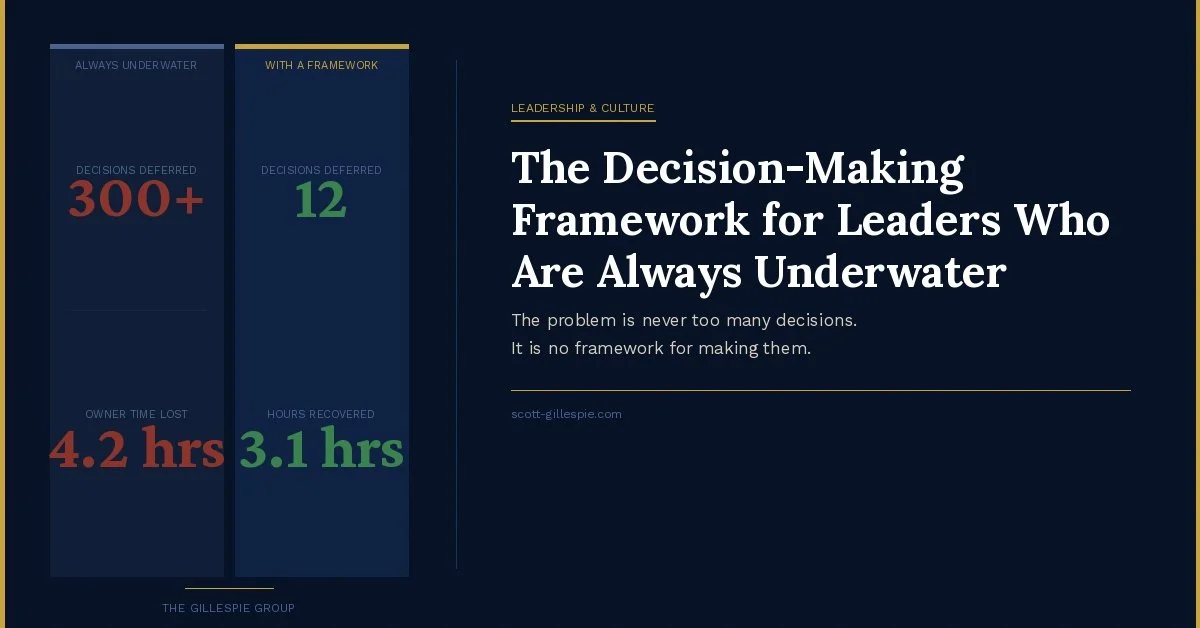
The Decision-Making Framework for Leaders Who Are Always Underwater
Your phone vibrates in your pocket for the fourteenth time since lunch. It is 2:14 PM, and every single one of those notifications represents a "quick question" from a team member, a vendor, or a client. You feel like you are gasping for air in a sea of trivialities. You built this business to gain freedom, yet you have become the central clearinghouse for every minor crisis within a ten-mile radius. You are underwater. You tell yourself that this is just the "cost of growth," but the truth is more uncomfortable. You are drowning because you lack a system for choosing what matters. You are treating every choice like a life-or-death struggle, and your brain is simply running out of fuel.

The Market Expansion Framework: Before You Enter a New Market
You stand at the edge of your current territory, looking at the map of the neighboring county or a new service vertical, and you see nothing but opportunity. Your current market feels crowded, or perhaps you have simply conquered it. You believe that "going big" in a new area is the logical next step to finally break through your revenue ceiling. You envision a second location, a new fleet of trucks, or a new suite of digital services that will double your size in eighteen months. This ambition is the engine of entrepreneurship, but without a rigorous framework, it is also the fastest way to set your current success on fire. Entering a new market is not just a growth play; it is a high-stakes capital allocation decision that demands more than a "gut feeling."
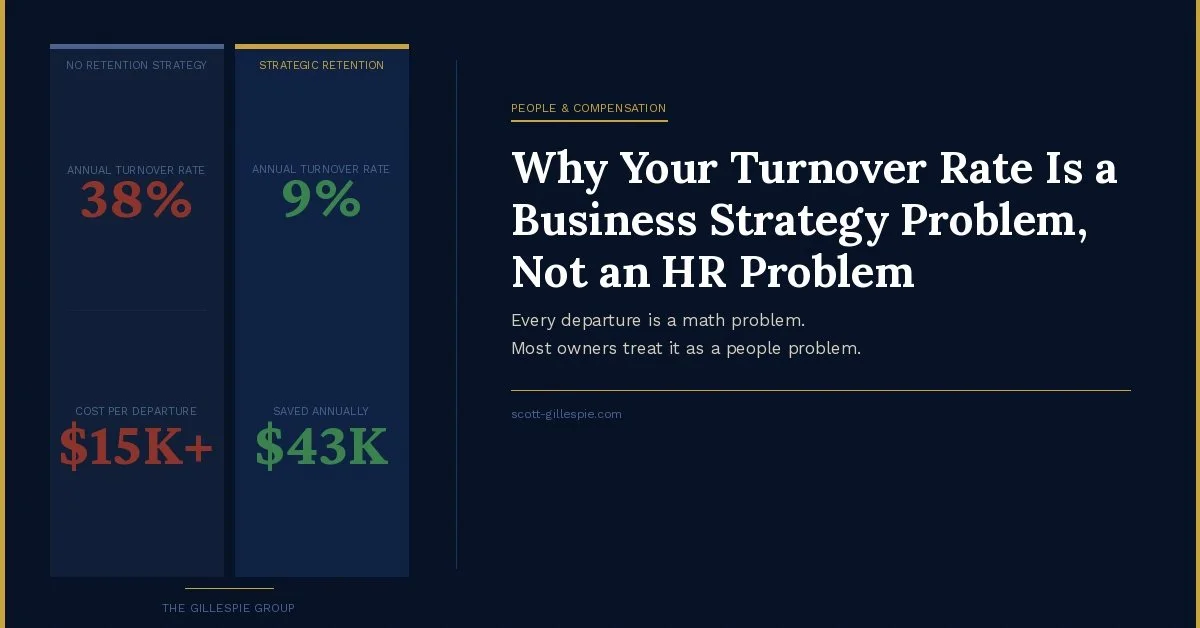
Why Your Turnover Rate Is a Business Strategy Problem, Not an HR Problem
You sit in your office, staring at the resignation email from your most reliable technician. They aren't leaving for a huge pay raise or a fancy title at a Silicon Valley startup. They are leaving to work for your direct competitor down the street for an extra two dollars an hour and a clearer schedule. Your first instinct involves frustration, followed quickly by an urge to call your office manager and demand they "fix" the hiring process. You view this departure as a human resources failure—a breakdown in recruiting or a lack of employee loyalty. This perspective is a comfortable lie that prevents you from seeing the truth. High employee turnover is rarely an HR problem; it is almost always a business strategy problem.
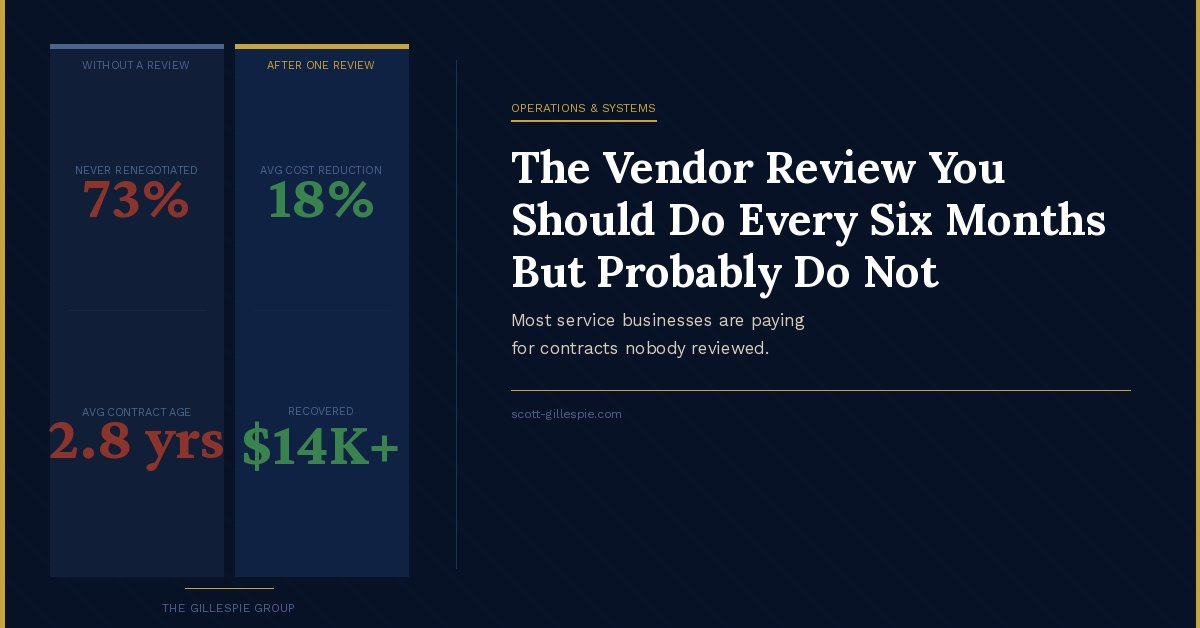
The Vendor Review You Should Do Every Six Months But Probably Do Not
You are paying for a version of a service that no longer exists. Years ago, when you were smaller and hungrier, you vetted every vendor with the intensity of a grand inquisitor. You compared every line item, negotiated every term, and demanded excellence because every dollar mattered. Today, you are busier. You have more clients, more staff, and a lot more noise in your head. Because of this, you have allowed your vendor relationships to enter a state of "set it and forget it." This neglect is costing you thousands of dollars in "lazy money"—the profit that leaks out of your business because you are paying 2026 prices for 2022 service levels.
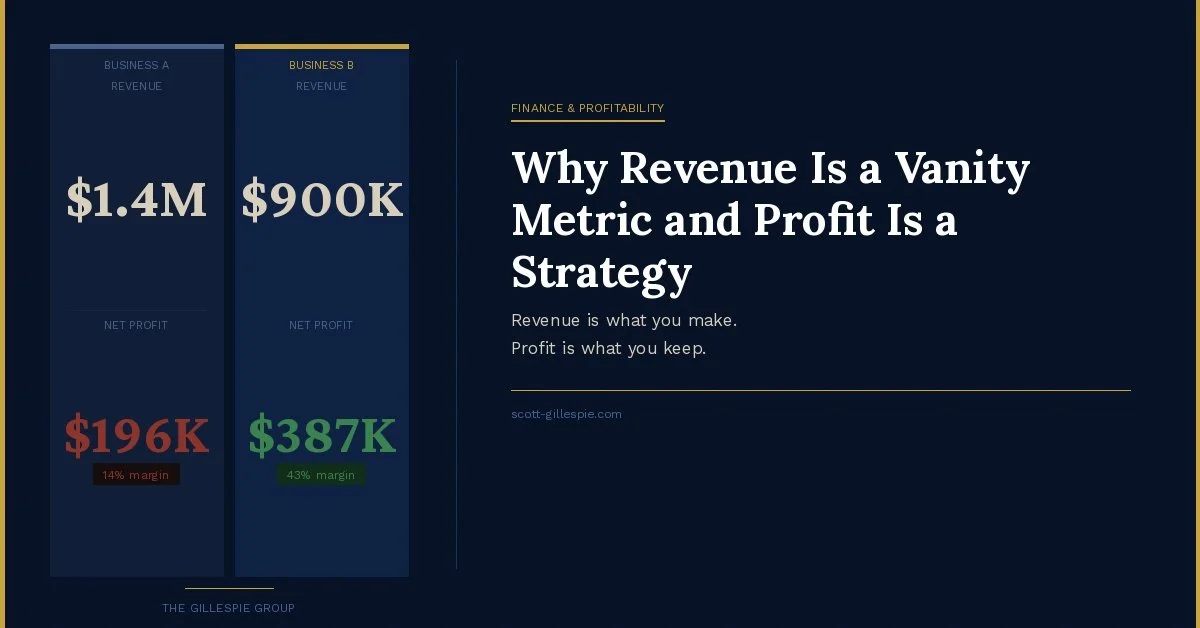
Why Revenue Is a Vanity Metric and Profit Is a Strategy
You stand at a networking event, drink in hand, and someone asks the inevitable question: "How’s the business doing?" You puff out your chest and mention your top-line revenue. "We're on track to hit $6 million this year," you say. The people around you nod with respect. They are impressed. You feel like a success. But when you get home and look at your bank balance, the feeling vanishes. You have millions flowing through the business, yet you struggle to cover payroll, your taxes are a constant source of anxiety, and you haven't taken a real distribution in months. You are living the "Big Revenue Lie."
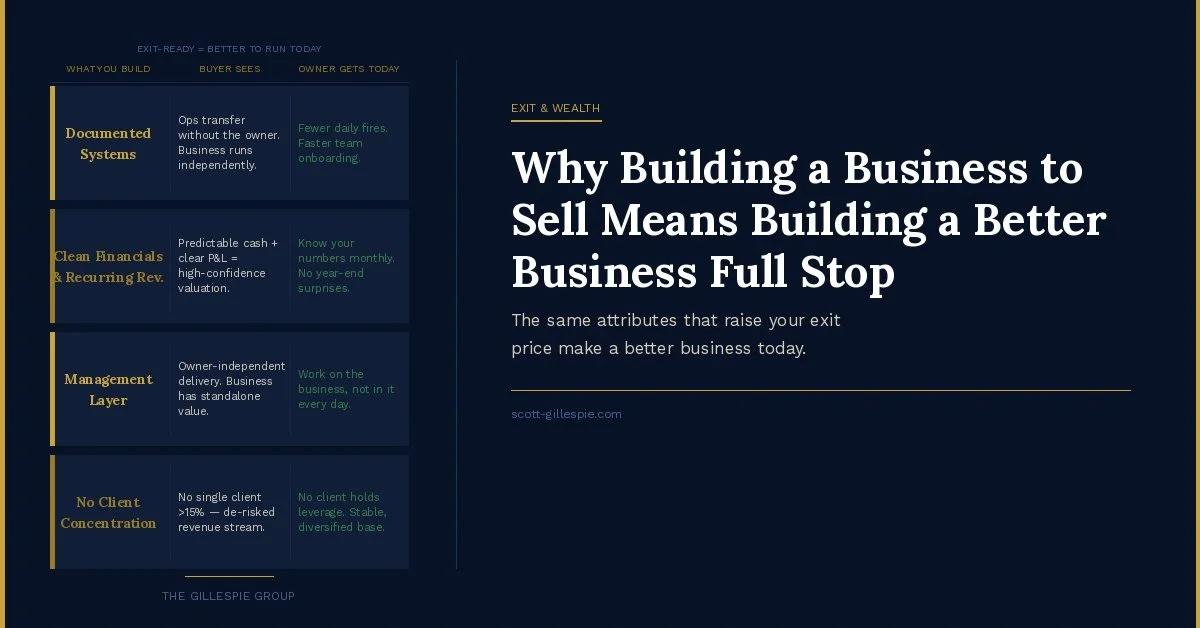
Why Building a Business to Sell Means Building a Better Business Full Stop
You likely tell yourself that you aren’t interested in selling. You built this company from the ground up, and you plan to run it until the day you decide to retire. You view "exit planning" as something for the future—a distant event that doesn't require your attention today. This perspective is a strategic mistake that limits your current revenue and tethers you to a business that cannot function without your constant input. The truth is simple: the disciplines required to make a business attractive to a buyer are the exact same disciplines that make a business profitable and peaceful for the owner to keep. When you build a business to sell, you inadvertently build a better business, full stop.
The most valuable asset in any service-based company isn't the equipment, the office lease, or even the client list. It is the ability of the business to produce a predictable result without the owner’s physical presence. Most small businesses under $10 million in revenue suffer from extreme owner-dependency. You are the lead salesperson, the chief problem solver, and the final word on every technical detail. While this makes you feel important, it makes the business worthless to an outsider. A buyer isn't looking to purchase a job; they are looking to purchase a cash-flow machine. If the machine breaks the moment you walk away, the machine has no value.
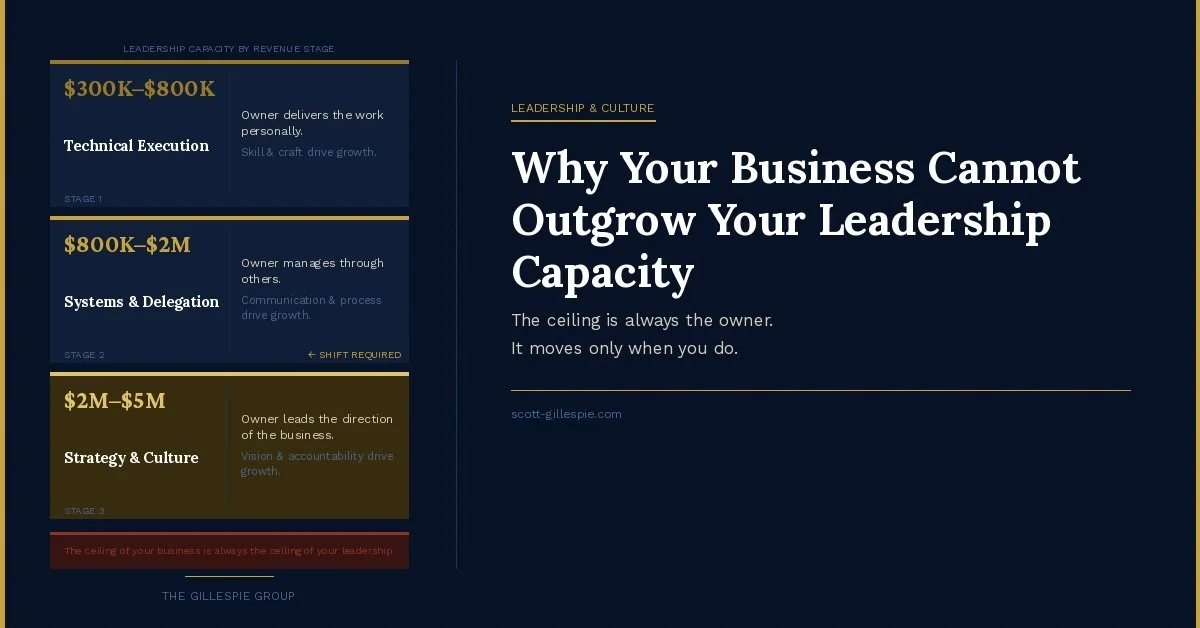
Why Your Business Cannot Outgrow Your Leadership Capacity
Your business has reached a plateau, and the view from the top of this particular hill feels remarkably like a cage. You built this company with grit, late nights, and a level of personal involvement that bordered on obsession. It worked. You crossed the seven-figure mark, hired a dozen people, and established a name in your market. But lately, the growth has stalled. You find yourself working harder than ever just to maintain the current volume, yet the revenue line on your profit and loss statement remains stubbornly flat. You feel like you are hitting an invisible ceiling every time you try to push for more. This frustration stems from a hard, physiological reality of commerce that most owners ignore until it breaks them. Your business cannot outgrow your leadership capacity.
The market does not care how much you want to grow. It only cares if your organization can handle the weight of that growth. Most small business owners treat their company like a backpack. When they want to grow, they just try to stuff more clients, more tasks, and more revenue into the bag. Eventually, the straps snap. The straps represent your leadership ability. If you have the leadership capacity of a $2 million owner, you will never successfully run a $10 million company. The complexity of the larger organization will crush you because you are still trying to lead using the same "technician-first" habits that got you started. To break through the ceiling, you must stop trying to grow the business and start trying to grow the person running the business.
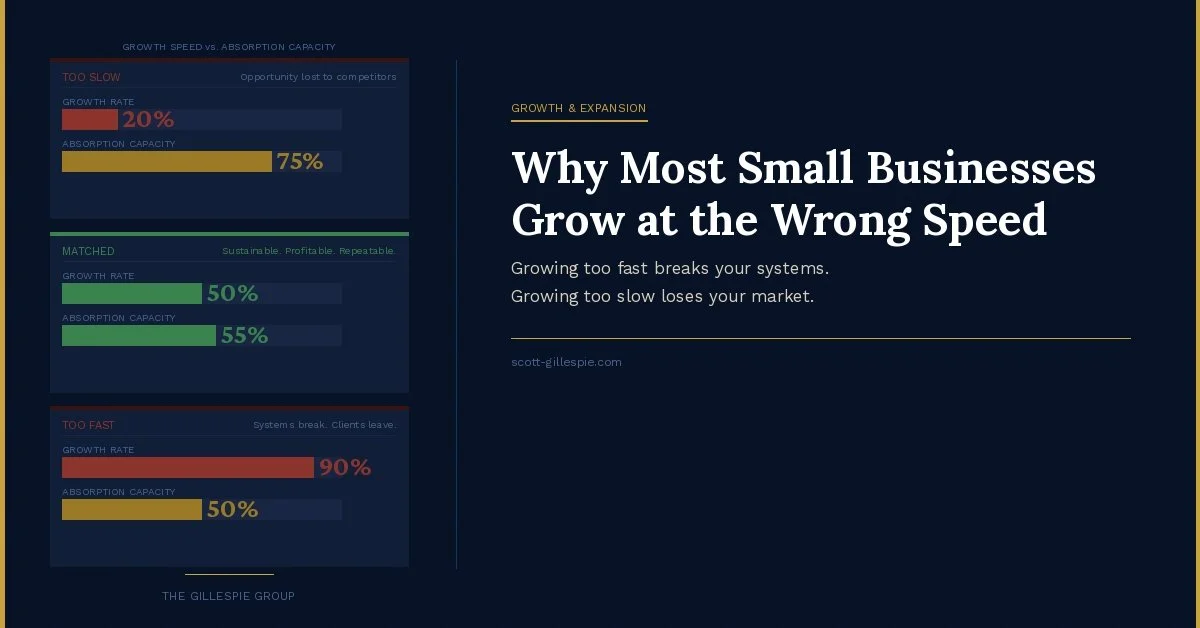
Why Most Small Businesses Grow at the Wrong Speed
Rachel ran a residential cleaning company in Minneapolis with eleven employees. In 2023, she had the best revenue year her business had ever produced. She added eighteen new accounts across twelve months, pushed hard on marketing, and closed deals she had been chasing for two years. On paper, everything worked.
By December she was seriously considering selling the business.
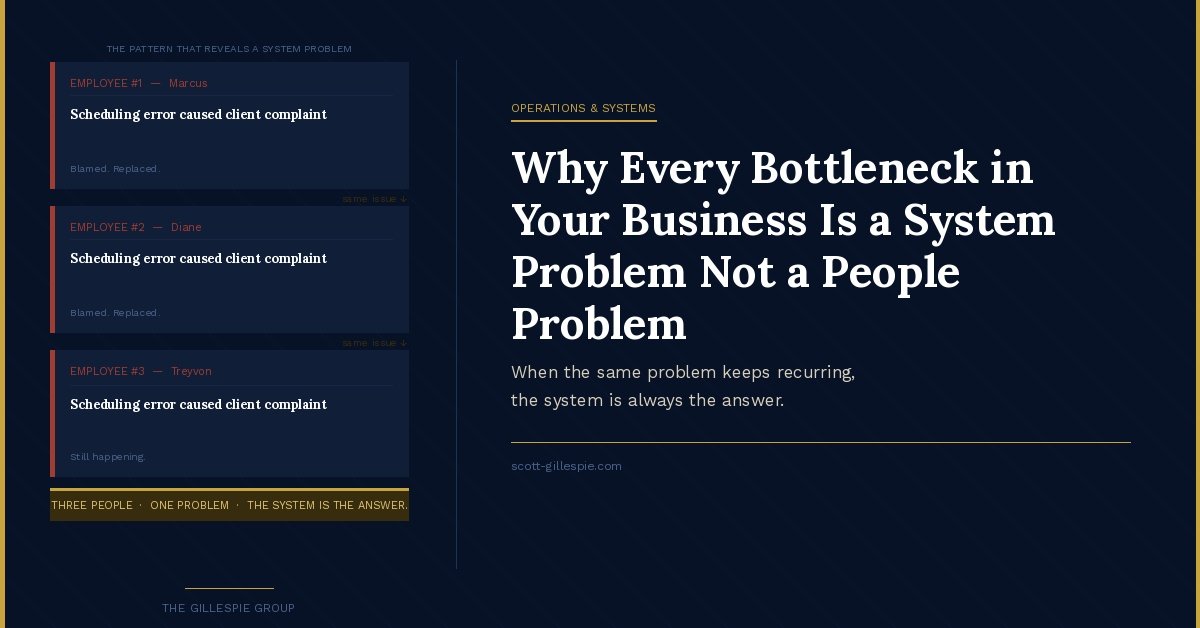
Why Every Bottleneck in Your Business Is a System Problem Not a People Problem
Three months after Kyle promoted his best field tech to service manager, he was ready to move her back. Calls from the field were still landing on his phone. Jobs were going out late. Clients were complaining about things that had nothing to do with the quality of the work. Kyle's new service manager looked overwhelmed, disorganized, and — frankly — not ready for the role.
He had been two days from having a very uncomfortable conversation with her when someone asked him a different question: what exactly had she been given to manage the job with?
Kyle thought about it. She had been given the title. She had been given the authority to direct the field crews. She had been given access to the dispatch calendar and the client files. What she had not been given was a documented escalation process for client complaints, a defined threshold for which field decisions she could make independently versus which ones required his sign-off, a standard for how jobs were supposed to be sequenced and dispatched when two high-priority requests landed on the same morning, or a single written procedure she could train the next person on if this ever needed to change.
She wasn't failing the system. She was operating without one. And Kyle was about to fire her for it.
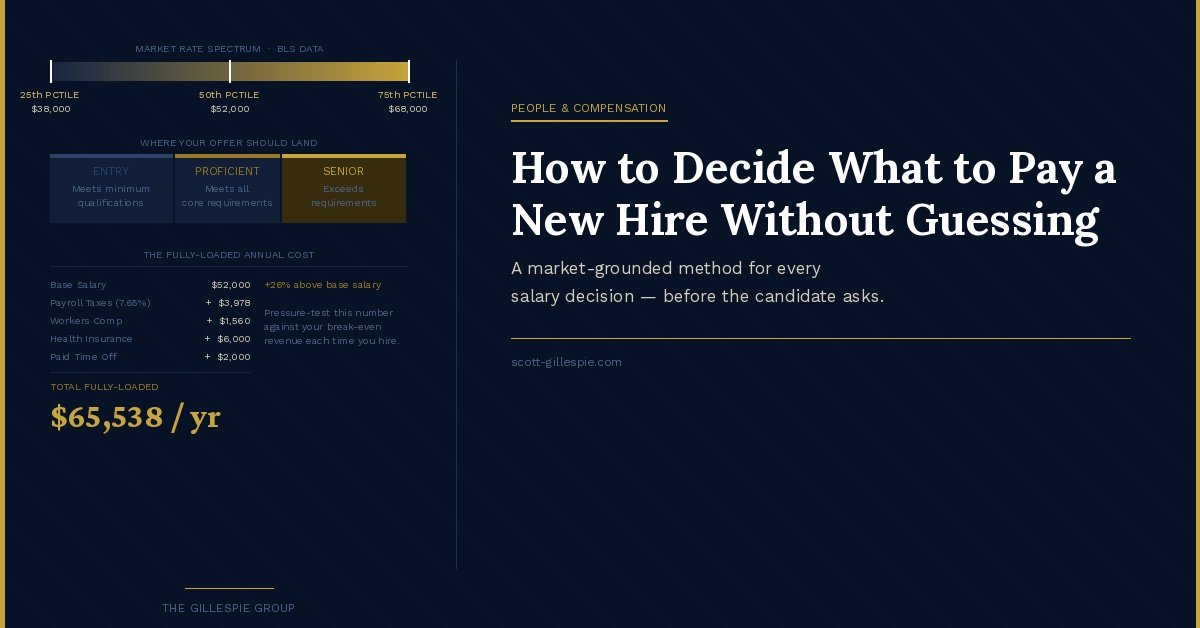
How to Decide What to Pay a New Hire Without Guessing
The candidate is sitting across from you. She's experienced, she interviewed well, and you want to hire her. Now she asks the question you've been half-dreading since the conversation started: "What does this role pay?"
Most service business owners answer this question one of two ways. Either they name a number they've carried in their head since they decided to hire — a number based on what they've paid before, what they heard a competitor was paying, or what the last person in the role accepted — or they throw the question back to the candidate and anchor to whatever she says. Neither approach is a strategy. Both are expensive.
Overpaying at hire compresses your margin immediately, sets a floor for every future compensation adjustment in the role, and creates internal equity problems the moment your existing team figures out what the new person earns. Underpaying gets you a candidate who accepts under duress and starts looking for another offer within six months — or a candidate who doesn't accept at all, leaving you to restart a hiring process that already costs you time and attention you don't have to spare.
The fix isn't complicated. It's a framework — a four-part method for arriving at a new hire salary that is grounded in market data, calibrated to your business's financial structure, and defensible in every direction.
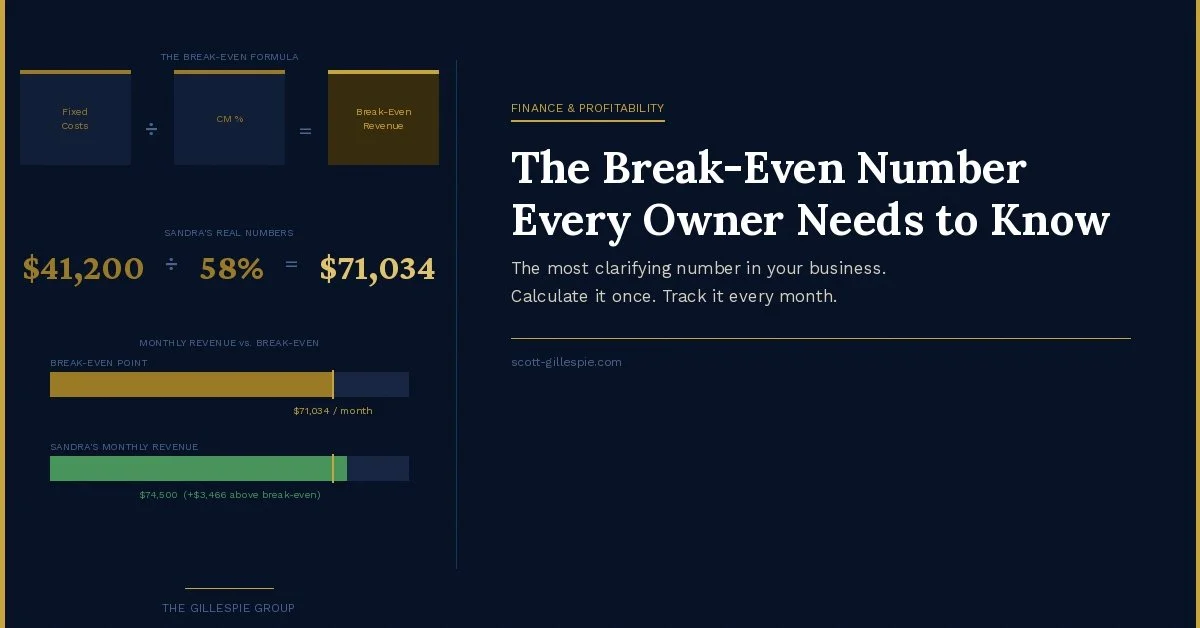
The Break-Even Number Every Owner Needs to Know
Sandra ran a residential electrical contracting business outside Nashville. Six employees, two vans, and a calendar that stayed full enough to feel comfortable. She raised her rates in January, picked up two new accounts in March, and hit her highest-revenue quarter ever in the spring.
She was also, somehow, tighter on cash than she'd ever been.
Revenue had climbed. Her bank account told a different story. She wasn't sure whether to be encouraged by the top line or worried by the bottom. And she had no way to answer the one question that would have oriented everything: at what point in the month does this business actually start making money?
That question has a precise answer. It's called your break-even point, and it's the most clarifying number a service business owner can know cold — not because it tells you how to grow, but because it tells you whether what you're doing right now is working, and exactly how much margin for error you actually have.

The Business Valuation Basics Every Owner Should Understand Before They Need Them
Paul built a commercial pest control company in central Florida over fourteen years. He had $2.1 million in revenue, a reliable team of twelve technicians, and a contract base that renewed at about 88% every year. He was good at the business and knew it. When a regional competitor approached him about an acquisition, he named a number he felt was fair — based on a rough sense of what the revenue was worth and what he needed to walk away comfortable.
The buyer's number was 40% lower.
Not because Paul's business wasn't valuable. Because Paul hadn't spent any time understanding what drives a business's value — which factors increase it, which factors compress it, and how a sophisticated buyer prices each one. The deal fell apart. Paul walked away from that table without knowing whether he had left money behind or dodged a lowball offer. He had no framework for judging either.
Most small business owners learn how business valuation works the week they decide they want to sell — or the week someone else decides they want to buy. That timing is exactly wrong. The owners who achieve the best exit outcomes understand valuation long before the conversation starts, because they spend the years before exit actively improving the variables that drive it. Here's the foundation.
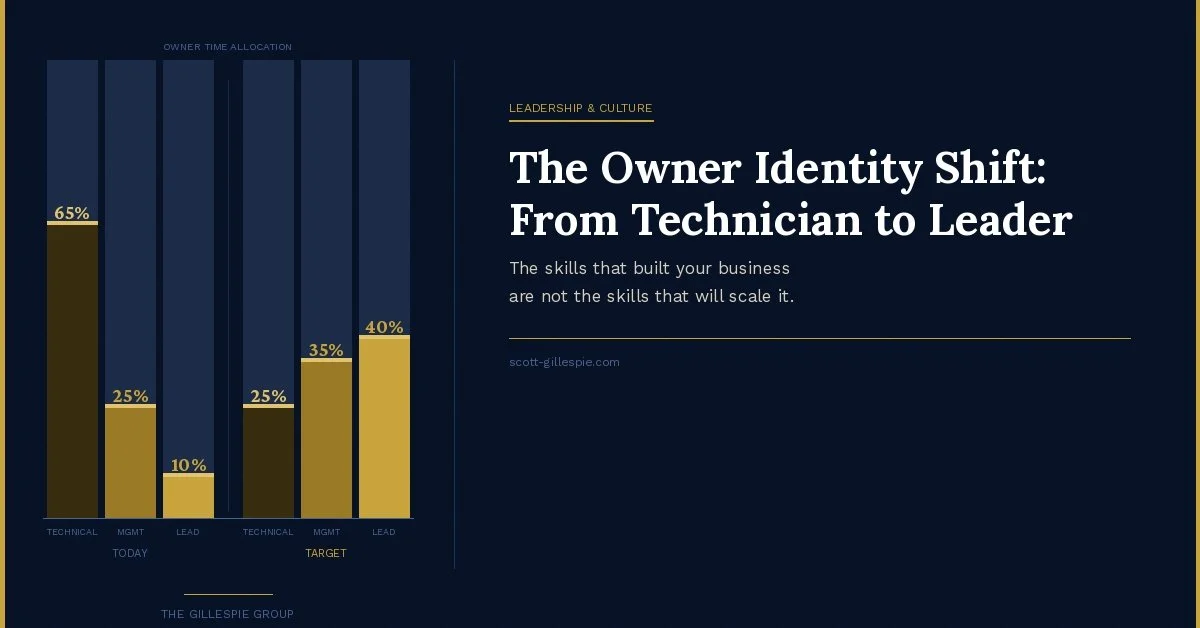
The Owner Identity Shift: From Technician to Leader
Jamie built her landscaping company with her hands. She knew soil composition, plant hardiness zones, drainage grades, and how to price a hardscaping job down to the last ton of stone. She was better at the technical work than anyone she ever hired. That competence was the business for the first four years — it drove the quality reputation that filled her calendar, earned the referrals, and funded the payroll.
By year five, she had eleven employees. And she was still on a crew three days a week.
Not because she had to be. Because she didn't know how not to be. The technical work was where she felt capable, confident, and useful. The leadership work — building the team, running the numbers, making the compensation decisions, having the accountability conversations — felt slippery. Uncertain. Like a role she wasn't sure she'd earned the right to play.
So she kept doing the work. And the business stayed exactly the size it was.
The pattern Jamie was trapped inside has a name. Michael Gerber mapped it in the 1980s, and three decades of research on small business growth has reinforced it consistently: most businesses plateau not because they hit a market ceiling, but because the owner never shifted roles. The skills that built the business — technical expertise, hands-on quality control, personal production — are not the skills that scale it. And the owners who can't make the shift don't fail. They just stop growing.
That shift is what this post addresses. The owner identity shift from technician to leader isn't a mindset seminar. It's a specific behavioral change, executed through a defined structure, over a deliberate timeline. Here's the framework.
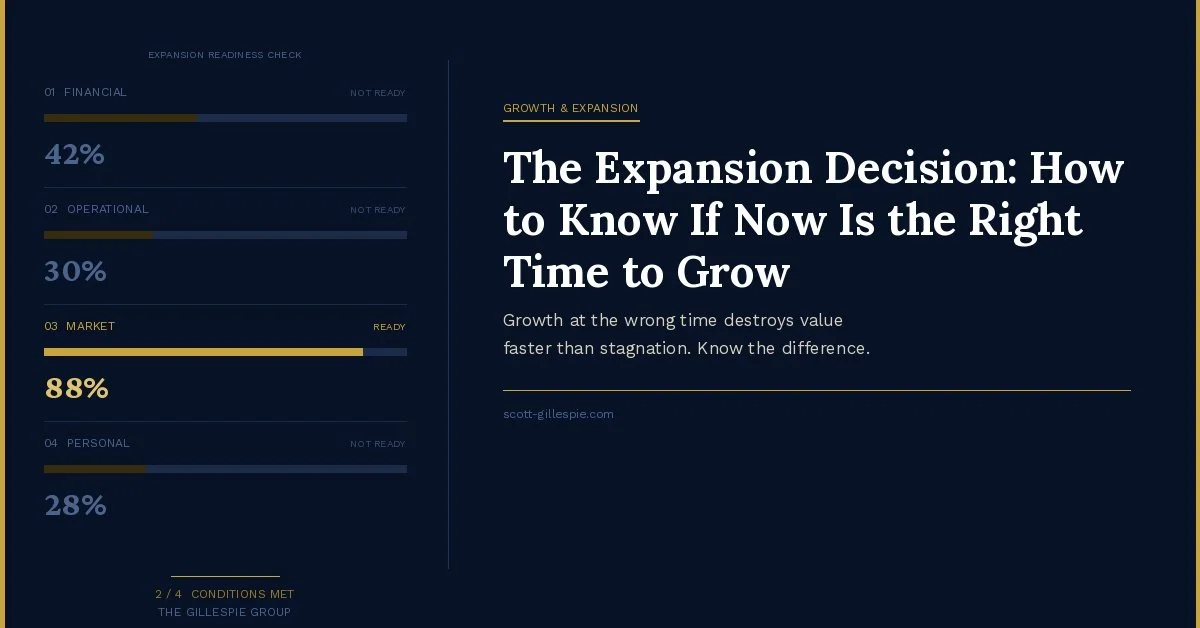
The Expansion Decision: How to Know If Now Is the Right Time to Grow
Chris ran a residential plumbing company in suburban Columbus. Five trucks, eight employees, about $1.4 million in revenue. He had more demand than he could service — calls he was turning away every week, a waiting list that stretched two weeks out, and a market that felt wide open. Every instinct he had said it was time to grow.
So he grew. Hired two technicians and a dispatcher. Leased a sixth truck. Rented a larger shop. Built out a basic office setup for the new dispatcher and invested in scheduling software he'd been putting off for two years. He was ready.
Fourteen months later, revenue had climbed to $1.7 million. His payroll had climbed to $890,000. His monthly debt service on the truck lease and shop build-out ran $8,400. His cash reserve — which had been sitting comfortably at $180,000 before the expansion — had dropped to $31,000. He lay awake on payroll weeks wondering whether the week's receivables would clear in time.
The business had grown. Chris felt like it was quietly killing him.
He hadn't made bad decisions. He had made good decisions at the wrong time, without a framework for knowing whether the conditions for expansion were actually met. The market signal was real. The demand was real. But the financial and operational foundation beneath that demand wasn't ready to carry the weight of what he built on top of it.
The business expansion decision is one of the highest-stakes choices a service business owner makes. Growth at the wrong time destroys value faster than stagnation. Stagnation at the wrong time lets a competitor fill the market you should have captured. Neither outcome is acceptable. What's needed is a framework that separates the excitement of the opportunity from the discipline of the readiness assessment.
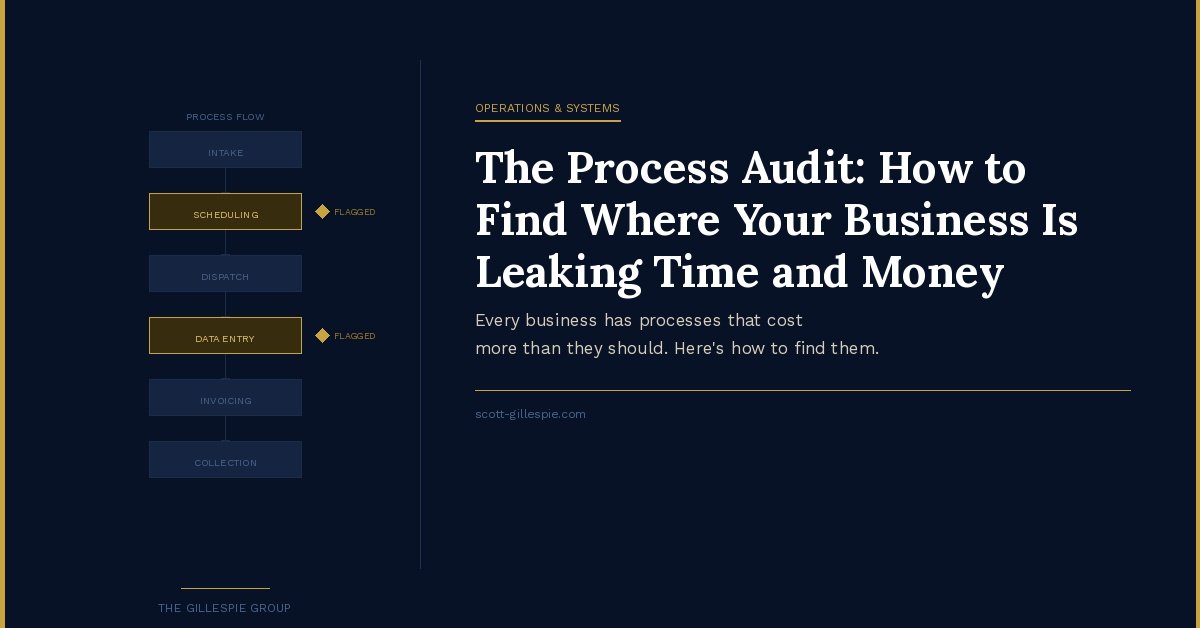
The Process Audit: How to Find Where Your Business Is Leaking Time and Money
Derek ran a seven-person HVAC service company outside Charlotte. Busy every single week — six technicians, a full dispatch calendar, and a reputation that kept the phone ringing. He worked 55 hours most weeks. His team worked hard. Revenue hovered around $1.1 million for three consecutive years without moving.
He wasn't losing customers. He wasn't underpriced. His team wasn't disengaged. The business just seemed to absorb every hour he poured into it and produce the same result. Busier than ever. Exactly the same size.
When someone finally asked Derek to walk through how a job moved from phone call to completed invoice, he described seven handoffs, three separate spreadsheets, two apps that didn't talk to each other, and a step where his office manager re-entered the same customer information into two different systems every single time. He had never counted the steps. He had just lived inside them for so long that they felt like the business — not friction the business happened to be carrying.
That friction had a cost. He just hadn't looked at it yet.
A process audit is the act of looking. It doesn't require a consultant or a technology investment or a weekend retreat. It requires a deliberate walk through every operational sequence in your business — asking at each step: does this create value, or does it simply consume time and money that could go somewhere else?

The Compensation Structure That Keeps Your Best People Without Bleeding Cash
Veronica ran a residential cleaning company with twelve employees. She had been in business for seven years and had never once lost a night of sleep over her team. Then, in a single quarter, three of her best people left. Not because she underpaid them. Not because the work dried up. Because they didn't know where they stood.
One of them told her on her way out the door: "I didn't know if staying made sense. Nobody ever told me what the path looked like."
Veronica had twelve employees and twelve separate compensation agreements — each one a product of a different negotiation, a different moment, a different level of urgency. None of them connected to each other. None of them told an employee anything about what came next. She had built a payroll. She had not built a system.
That distinction is what this post addresses. Your employee compensation structure — the architecture that defines how your small business pays people, how it advances them, and what they can expect — is either a retention tool or a departure accelerator. There is very little in between.
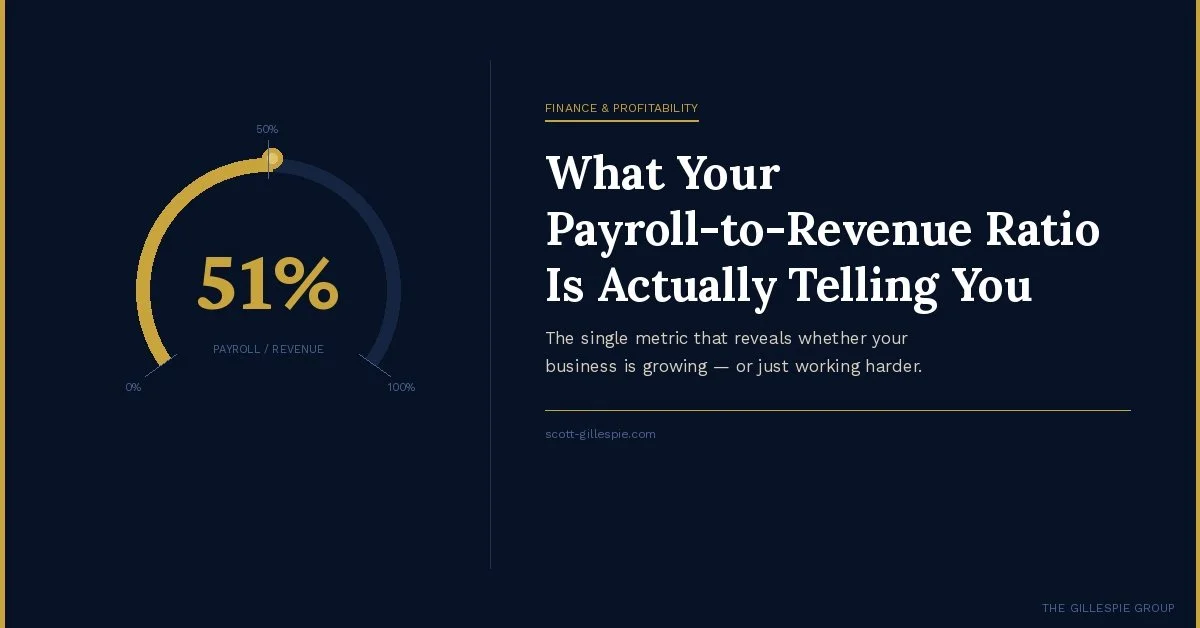
What Your Payroll-to-Revenue Ratio Is Actually Telling You
Marcus ran a commercial cleaning company out of Atlanta. Nine years in business, seven employees, three vans, and about forty commercial accounts. Revenue had climbed from $380,000 to just over $820,000 in four years. From the outside — and from where Marcus stood — the business looked healthy.
Then someone asked him what his payroll-to-revenue ratio was.
He didn't know. Not because he was inattentive. He ran payroll every two weeks and tracked the totals. But he had never calculated the ratio — never looked at what his labor investment represented as a percentage of the revenue it was supposed to generate. He was watching the dollar amount. He had stopped reading what the dollar amount meant.
When he finally ran the number, it was 51%.
That single figure explained everything: the months when revenue looked fine but cash felt strained, the raises that seemed affordable at the time but never improved the margin, the persistent feeling that the business worked harder than it grew. The payroll-to-revenue ratio had been sending a signal for years. Nobody had told Marcus it was worth reading.
Your business is sending the same signal right now. Here's how to read it.