Golden Handcuffs: How to Reward Key Employees Without Giving Up Equity
As your small business expands past your first few million dollars in top-line revenue, you realize that your company cannot grow further without high-performing executive leadership. You recruit a stellar Chief Operating Officer, a veteran VP of Sales, or a brilliant technical director who stabilizes daily operations and drives profitability. Soon after, the retention conversation begins. Your top manager asks for an equity stake in the company, or you voluntarily consider granting them five or ten percent voting stock to keep them committed for the long haul. Giving away corporate equity to retain non-founder key employees is one of the most dangerous mistakes a business owner can make.
Why Cash Value Life Insurance is the Ultimate Roth IRA for Business Owners
When financial advisors discuss tax-free wealth accumulation, the Roth IRA is universally praised as the premier retail investment vehicle. A Roth IRA allows individuals to contribute after-tax dollars, grow their investment returns completely tax-deferred, and extract tax-free income distributions during retirement. For successful small business owners generating millions of dollars in corporate revenue, the traditional Roth IRA is virtually useless. Federal tax laws enforce strict personal income eligibility phase-outs that disqualify high-earning founders from contributing directly to a Roth IRA once their income exceeds modest threshold caps.
Life Insurance vs SEP IRA and 401k for Small Business Owners
As a small business owner generating millions of dollars in top-line revenue, traditional financial advice tells you to dump excess profit into qualified retirement plans like a SEP IRA or a traditional 401k. Traditional financial planners sell these plans on a single metric: immediate upfront tax deductions. When your operating profits expand, taking a dollar-for-dollar tax write-off seems like an obvious choice to lower your annual tax bill. Qualified retirement plans contain rigid structural drawbacks that actively penalize profitable, growing business owners.
How to Use Life Insurance to Keep Key Employees in Your Small Business
Your business relies on a small handful of critical individuals who drive client retention, maintain technical standards, and manage operational execution. If your head of operations, lead engineer, or top revenue producer walked out the door tomorrow to join a competitor, your profit margins would collapse. Most small business owners operating under ten million dollars in revenue recognize this key person risk, yet they rely on basic equity promises or standard salary increases to keep top talent from leaving. Salary increases alone fail to build long-term retention because competitors can always outbid a basic base pay offer. You need a structural financial incentive that ties your critical team members to the enterprise for a decade or more without diluting your equity ownership.
The Flawed Commission Scheme: How to Design Sales Incentives That Protect Profit Margins
Every month, you hand out fat commission checks to your sales team while watching your net profit margin shrink. You celebrate record-breaking top-line revenue numbers, yet your operating cash account barely covers next week's payroll. You tell yourself that sales fix everything. You assume that if you just close more deals, the overhead costs will dilute, the operational efficiencies will kick in, and profit will naturally follow. That financial logic is completely broken.
The Documentation Standard That Protects You in Every Personnel Decision
You sit at your desk dreading the conversation you must have this afternoon. You employ a highly toxic technician who constantly arrives late, disrespects your dispatchers, and executes sloppy work in the field. You know you need to terminate their employment immediately to protect the morale of your entire company. But a cold knot of anxiety forms in your stomach. You hesitate. You realize that you possess absolutely zero written proof of their repeated failures. You issued dozens of verbal warnings over the past six months, but you never wrote a single word down on paper.
You fear the retaliation. You fear a wrongful termination claim. You feel trapped by your own administrative laziness. This paralyzing fear represents a massive operational failure. When you manage a service-based business under ten million dollars in revenue, your people represent both your greatest asset and your greatest liability. Relying on memory and casual conversations to govern your workforce is a choice to operate completely exposed. You must build a rigid HR documentation small business legal protection framework to shield your profit and your sanity. Documentation is not corporate bureaucracy. It is the absolute, unyielding armor of a professional chief executive.
How to Structure a Commission Plan That Motivates Without Creating Chaos
You look at your sales tracking board and see a massive new contract. Your lead representative just closed a deal that will supposedly double your revenue for the month. You feel a brief moment of intense relief. Then you actually look closely at the details of the agreement. The salesperson promised an incredibly tight, entirely unreasonable deadline. They included specialized services your operational team rarely performs. They gave the client a massive twenty percent discount just to secure the signature today. You feel a sudden surge of anger toward your employee. You call them into your office and berate them for their total lack of operational awareness.
Why Most Owners Underpay Stars and Overpay Underperformers
You sit in your office reviewing the upcoming payroll run. You look at the roster and see the name of your absolute best technician. This individual handles your most demanding clients, never complains about the schedule, and consistently delivers flawless execution. Then you look further down the spreadsheet and see the name of a mediocre employee who constantly shows up late, requires endless supervision, and routinely damages equipment. You realize, with a sudden sickening feeling, that the hourly pay gap between these two completely different individuals sits at a mere two dollars. You believe you treat everyone fairly. In reality, you actively insult your elite talent while heavily subsidizing total incompetence. You must fix the severe crisis of employee pay equity small business high performers face before your top producers walk out the door forever.
The Offer Letter Framework Every Owner Needs
You finally find the perfect candidate. You endure weeks of terrible interviews, sift through dozens of mediocre resumes, and battle the exhaustion of an empty schedule. When the right person sits across from your desk, you feel a massive wave of relief. You offer them the position immediately. You shake their hand, agree on an hourly wage, and send them a quick, casual email confirming their start date. You assume you just solved your capacity problem. You actually just created a massive operational liability. A casual job offer operates as a ticking time bomb inside your company.
Building a Benefits Package That Attracts Talent Without Overpaying
Every morning, you look at your team and wonder who will hand you a resignation letter next. You feel the constant pressure of large corporations looming over your local market. They offer shiny perks and gold-plated health insurance that seem absolutely impossible for your small operation to match. You assume your lack of a massive corporate budget makes you a sitting duck for aggressive talent poachers. This belief operates as a defensive lie. It prevents you from building a high-performance culture. You do not need a massive human resources department to win the war for talent. You need a benefits strategy that prizes relevance over raw spending.
How Incentive Pay Works and When It Does Not
You hand out a bonus check and expect profound gratitude. You anticipate a massive spike in productivity. Instead, you get a quick nod, a mumbled thanks, and a team that goes right back to the exact same mediocre performance the very next morning. You believe that money automatically creates motivation. You think a financial carrot dangling on a stick will solve your operational friction and cure your bad morale. So you create a complex variable compensation plan. You pay your technicians extra money simply for showing up on time. You pay your sales team a flat commission for every single signed contract, regardless of the profit margin.
When to Promote vs. When to Hire From Outside
You look at your lead technician. They show up early every morning. They execute the work flawlessly. They know your most demanding clients by their first names. A management position just opened up in your company, and they expect you to hand them the job. You want to reward their loyalty. You feel an intense pressure to give them the title. But a quiet, persistent doubt lingers in your mind. You wonder if they can actually lead people. This moment represents a critical junction in your business. Promoting the wrong person out of guilt destroys your culture and stifles your growth. You must evaluate this choice with clinical precision.
The Performance Review That Actually Changes Behavior
You sit across the desk from your employee. You hold a generic form you printed from the internet fifteen minutes ago. You nervously clear your throat and attempt to deliver a feedback sandwich. You offer a vague compliment, quickly mumble something about needing to improve communication, and then rush into another compliment to soften the blow. You end the meeting by granting a standard cost-of-living raise. The employee leaves the room completely confused about their actual standing in the company. Two weeks later, the exact same operational mistakes keep happening. You feel frustrated and assume you just hired unmotivated people. This assumption represents a massive failure in leadership.
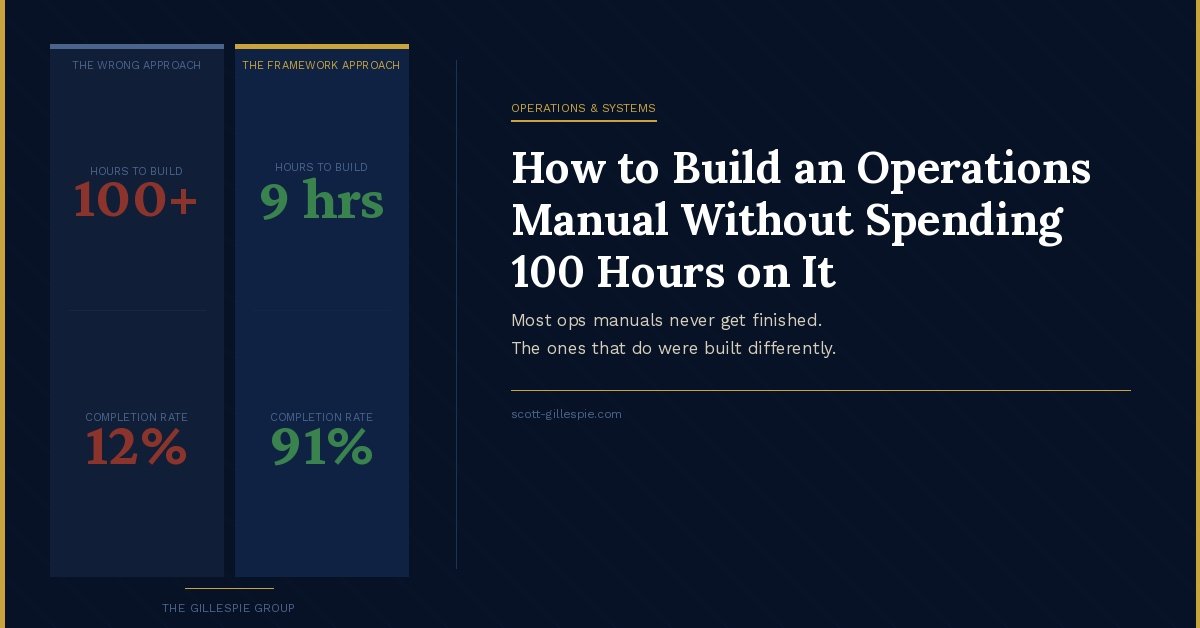
How to Build an Operations Manual Without Spending 100 Hours on It
You are the most expensive person in your building, yet you spend half your day acting like a biological Google search engine for your staff. Every time an employee knocks on your door to ask how to handle a specific client complaint or where to find the login for a vendor portal, your growth stops. You built this business on your personal expertise, but that expertise has now become your prison. You know you need an operations manual. You know you need documented systems. But every time you look at that blank Word document, you imagine a six-month project that involves hundreds of hours of typing and formatting. You decide you don't have the time, so you go back to putting out fires. This delay is a choice to stay small.
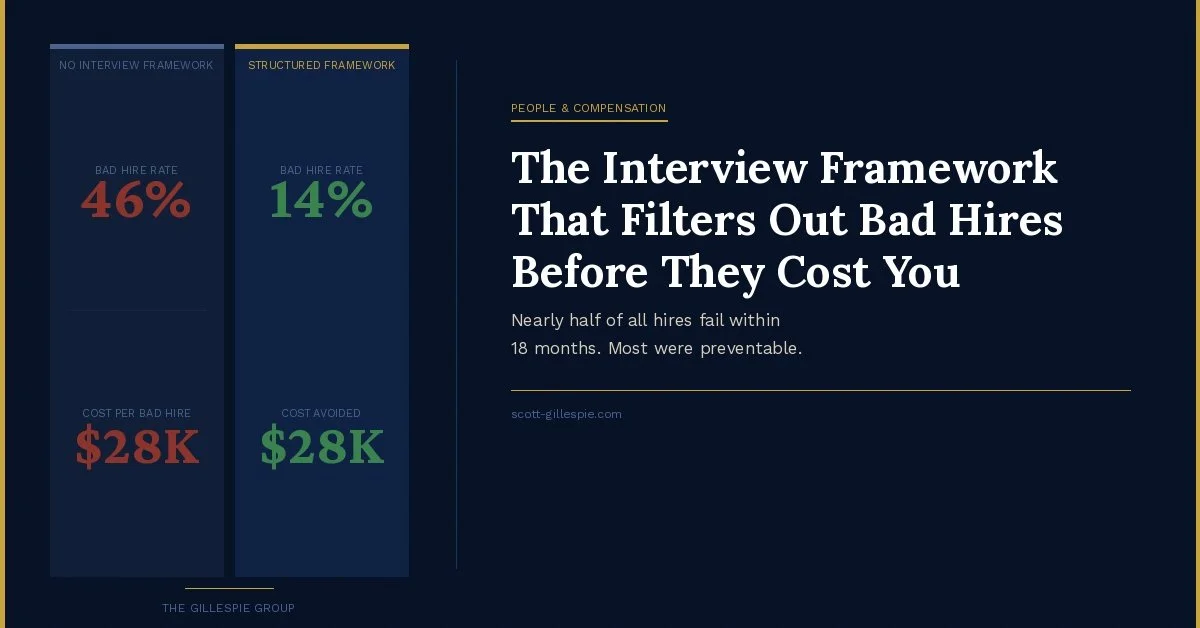
The Interview Framework That Filters Out Bad Hires Before They Cost You
You sit across from a candidate who looks perfect on paper. Their resume boasts the right certifications, their past titles suggest experience, and they possess a level of charisma that makes you want to grab a beer with them. You feel that familiar rush of relief because you are desperate to fill a seat. You hire them based on this "gut feeling," believing that your intuition is your greatest superpower. Three months later, you find yourself back in your office, staring at a mounting pile of client complaints and a toxic vibe that has infected your previously high-performing team. You realize that your intuition lied to you. The wrong hire doesn’t just cost you the salary you paid them; it costs you the momentum of your entire company.
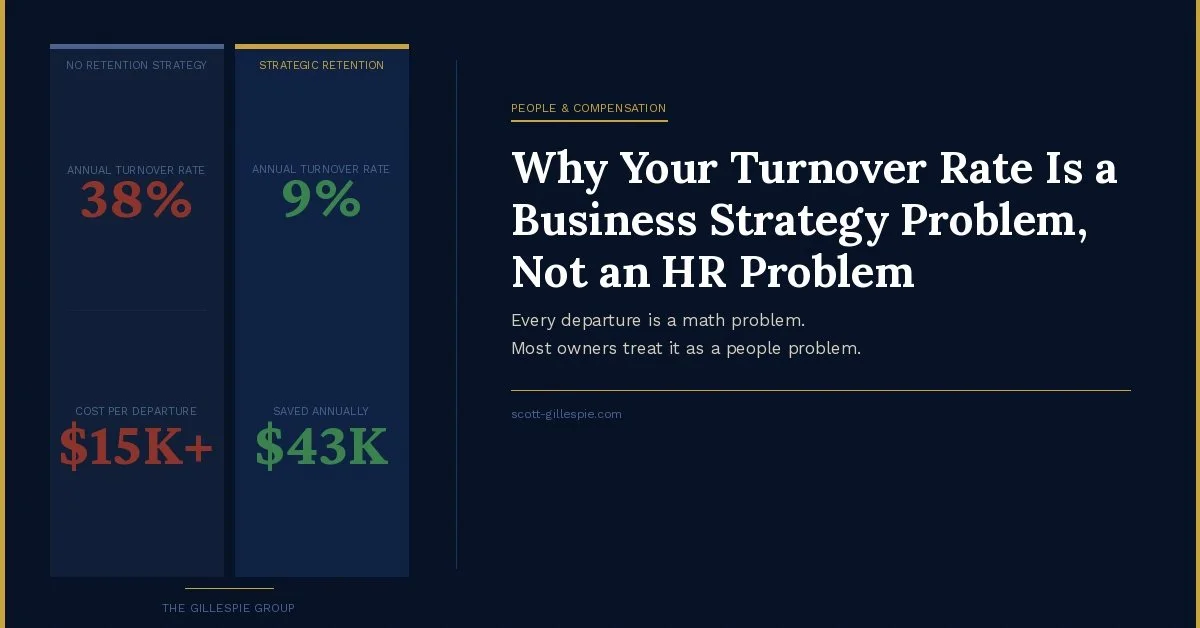
Why Your Turnover Rate Is a Business Strategy Problem, Not an HR Problem
You sit in your office, staring at the resignation email from your most reliable technician. They aren't leaving for a huge pay raise or a fancy title at a Silicon Valley startup. They are leaving to work for your direct competitor down the street for an extra two dollars an hour and a clearer schedule. Your first instinct involves frustration, followed quickly by an urge to call your office manager and demand they "fix" the hiring process. You view this departure as a human resources failure—a breakdown in recruiting or a lack of employee loyalty. This perspective is a comfortable lie that prevents you from seeing the truth. High employee turnover is rarely an HR problem; it is almost always a business strategy problem.