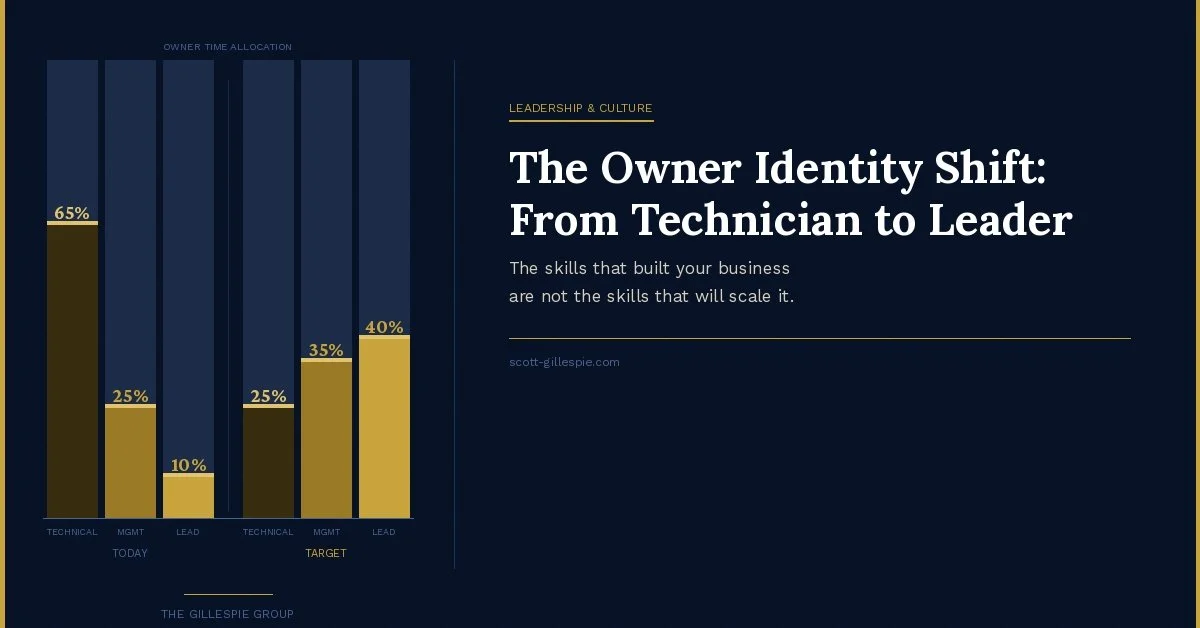
The Owner Identity Shift: From Technician to Leader
Jamie built her landscaping company with her hands. She knew soil composition, plant hardiness zones, drainage grades, and how to price a hardscaping job down to the last ton of stone. She was better at the technical work than anyone she ever hired. That competence was the business for the first four years — it drove the quality reputation that filled her calendar, earned the referrals, and funded the payroll.
By year five, she had eleven employees. And she was still on a crew three days a week.
Not because she had to be. Because she didn't know how not to be. The technical work was where she felt capable, confident, and useful. The leadership work — building the team, running the numbers, making the compensation decisions, having the accountability conversations — felt slippery. Uncertain. Like a role she wasn't sure she'd earned the right to play.
So she kept doing the work. And the business stayed exactly the size it was.
The pattern Jamie was trapped inside has a name. Michael Gerber mapped it in the 1980s, and three decades of research on small business growth has reinforced it consistently: most businesses plateau not because they hit a market ceiling, but because the owner never shifted roles. The skills that built the business — technical expertise, hands-on quality control, personal production — are not the skills that scale it. And the owners who can't make the shift don't fail. They just stop growing.
That shift is what this post addresses. The owner identity shift from technician to leader isn't a mindset seminar. It's a specific behavioral change, executed through a defined structure, over a deliberate timeline. Here's the framework.