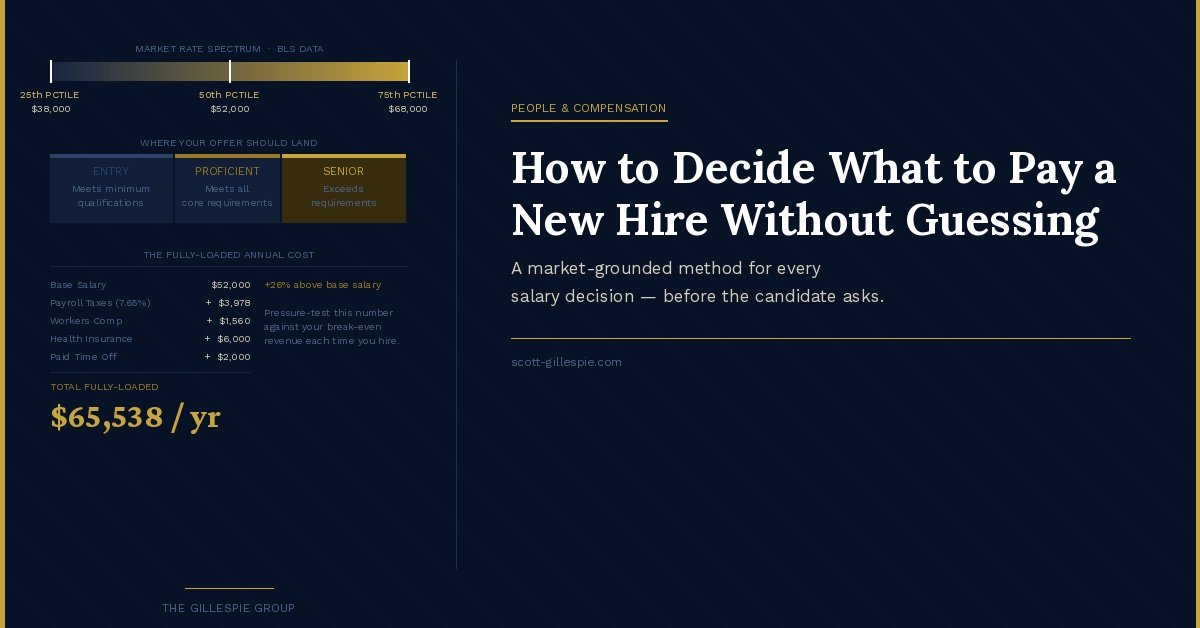
How to Decide What to Pay a New Hire Without Guessing
The candidate is sitting across from you. She's experienced, she interviewed well, and you want to hire her. Now she asks the question you've been half-dreading since the conversation started: "What does this role pay?"
Most service business owners answer this question one of two ways. Either they name a number they've carried in their head since they decided to hire — a number based on what they've paid before, what they heard a competitor was paying, or what the last person in the role accepted — or they throw the question back to the candidate and anchor to whatever she says. Neither approach is a strategy. Both are expensive.
Overpaying at hire compresses your margin immediately, sets a floor for every future compensation adjustment in the role, and creates internal equity problems the moment your existing team figures out what the new person earns. Underpaying gets you a candidate who accepts under duress and starts looking for another offer within six months — or a candidate who doesn't accept at all, leaving you to restart a hiring process that already costs you time and attention you don't have to spare.
The fix isn't complicated. It's a framework — a four-part method for arriving at a new hire salary that is grounded in market data, calibrated to your business's financial structure, and defensible in every direction.

The Compensation Structure That Keeps Your Best People Without Bleeding Cash
Veronica ran a residential cleaning company with twelve employees. She had been in business for seven years and had never once lost a night of sleep over her team. Then, in a single quarter, three of her best people left. Not because she underpaid them. Not because the work dried up. Because they didn't know where they stood.
One of them told her on her way out the door: "I didn't know if staying made sense. Nobody ever told me what the path looked like."
Veronica had twelve employees and twelve separate compensation agreements — each one a product of a different negotiation, a different moment, a different level of urgency. None of them connected to each other. None of them told an employee anything about what came next. She had built a payroll. She had not built a system.
That distinction is what this post addresses. Your employee compensation structure — the architecture that defines how your small business pays people, how it advances them, and what they can expect — is either a retention tool or a departure accelerator. There is very little in between.