How to Reduce Owner Dependency and Build a Business That Reliably Runs Without You
You built this company from a laptop and a single mobile phone. In the beginning, your personal intervention was the only thing standing between victory and total operational collapse. You answered every phone call at dawn. You closed every difficult sale. You personally fixed every customer complaint at two in the morning. That relentless effort was required to survive stage one of your venture. The problem is that you never stopped doing it. You built a high-paying job for yourself disguised as a scalable enterprise, and now you are trapped inside the very engine you designed. Every single morning, you wake up to an inbox overflowing with micro-decisions, crisis escalations, and tactical approvals. You wear the badge of being the hardest worker in the room like a medal of honor. Stop wearing it. It is not an honor. It is a structural failure.
The Player-Coach Trap: Why Stepping onto the Field Destroys Your Enterprise Value
You wake up at five in the morning, check your phone, and immediately spot three client emergencies that require your direct intervention. By eight o'clock, you are on the phone reassuring a key client because your lead account manager dropped the ball. By noon, you are writing technical proposals, jumping into production, or personally fixing a service delivery mistake that should have been handled two management layers below you. You tell yourself this is what leadership looks like. You convince yourself that staying close to the work guarantees quality, preserves client relationships, and protects your margin. That self-delusion is actively destroying the valuation of your company.
Why Open Door Policy Is the Least Effective Management Strategy
You sit in your office with the door propped wide open. You take immense pride in this physical arrangement. You constantly tell your staff that you operate with total transparency and that you care deeply about their daily struggles. A junior technician walks in, sits down uninvited, and spends fifteen minutes explaining a minor conflict with a local vendor. You stop analyzing your monthly profit and loss statement to listen. You offer a quick, definitive solution to the problem. The employee thanks you enthusiastically, and they walk out. You feel like a highly engaged, empathetic boss. In reality, you just committed a profound act of gross managerial negligence.
How to Handle Conflict Between Team Members Without Becoming the Referee
An employee knocks on your office door. They step inside, close the door behind them, and immediately launch into a bitter complaint about a fellow team member. They tell you that a senior technician spoke to them disrespectfully, or that the dispatcher assigned them an unfair route. You listen carefully. You feel a familiar, exhausting tension rise in your chest. You promise to look into the situation and handle it. They leave the room feeling validated, but you are now trapped. You just accepted the role of the company referee. You took their emotional burden and placed it squarely onto your own shoulders.
The Feedback Conversation That Changes a Person's Performance Permanently
You pull an employee into your office. You sit them down to discuss a massive mistake they made on a job site yesterday. You feel nervous. You try to soften the blow by complimenting their punctuality before quickly mentioning the error, and then you frantically pivot back to praising their positive attitude. The employee leaves the room smiling. You feel relieved that the conversation avoided conflict. Two days later, the exact same operational mistake happens again. You feel a massive surge of anger. You assume the employee simply refuses to care. This assumption provides a comfortable excuse, but it masks a brutal failure in your own daily leadership. Your feedback failed completely because you prioritized your own emotional comfort over their professional clarity.
Why Your Team Reflects Your Leadership More Than Your Hiring
You review a stack of resumes. You conduct three rounds of interviews. You find the perfect candidate. You pay top dollar to secure their talent. You feel a massive sense of relief because you finally hired an absolute professional. Six months later, you watch this exact same individual show up late, cut corners on the job site, and deliver a completely mediocre result to your best client. You feel cheated. You blame the candidate. You blame the recruiter. You complain to your peers that nobody wants to work hard anymore. This comfortable lie protects your ego. The brutal truth cuts much deeper.
The Leadership Communication Framework for Small Business Owners
You spend your entire day talking to your staff. You issue clear directives on Monday morning. By Wednesday afternoon, you watch your technicians completely ignore those instructions and revert to their old, inefficient habits. You explain a critical new pricing strategy during a company-wide morning meeting. A week later, your sales manager still offers the old discount to a legacy client. You start to wonder if your staff simply ignores you on purpose. You assume they lack motivation or simply refuse to listen to your authority. This assumption provides a comfortable excuse for your frustration, but it hides a deeply uncomfortable operational truth. Your team does not possess a listening problem. You possess a communication problem.
How to Run a Business Meeting That Actually Moves Things Forward
You sit at the head of the conference table. Five of your highest-paid employees stare back at you. You spend forty-five minutes talking about improving communication. People share random anecdotes. They complain about late vendor deliveries. They argue over the quality of the new breakroom coffee. You feel like a democratic leader because you gave everyone a voice. Then the clock hits the hour mark. Everyone stands up to leave. You suddenly realize nothing actually happened. No one took ownership of a new deadline. No one made a firm decision. Your technicians are now an hour behind on their revenue-producing routes. You just paid a massive tax on your own profit. You must redesign your gatherings before your calendar becomes the graveyard of your growth.
The Leadership Communication Framework for Small Business Owners
You talk all day long, yet your team still seems to play an entirely different game. You give clear directives on Monday morning. By Wednesday afternoon, your technicians are back to their old habits. You explain a critical new pricing strategy in a morning meeting. A week later, your sales manager still offers the old discount to a legacy client. You start to wonder if your staff simply ignores you. You assume they lack motivation or simply refuse to listen. This assumption provides a comfortable excuse, but it hides a deeply uncomfortable truth. Your team does not possess a listening problem. You possess a communication problem.
Why Delegation Feels Like Loss of Control and How to Get Over It
You look at the email draft your newly promoted manager prepared and your chest immediately tightens. You see three minor formatting errors and a sentence that does not sound exactly like your personal voice. You delete the entire message and rewrite it yourself. You click send. You tell yourself that excellence requires a personal touch. You believe that nobody else cares as much as you do about the client experience. This belief creates a comfortable prison. You assume that doing the work guarantees the quality of the work. This specific mindset represents the ultimate delegation challenge small business owner control issue. You confuse micromanagement with high standards. You mistake your own physical exhaustion for dedicated leadership.
The Accountability System That Works in a Business of Any Size
Nagging is not leadership. It is a choice to stay small. You likely spend your afternoons repeating instructions you already gave three times this morning. You catch an employee making a mistake and you point it out with a heavy sigh. They apologize and they promise to do better. You feel like you are coaching them. You feel like a "hands-on" owner. But two weeks later the identical mistake happens again. This cycle is exhausting. It is the reason you feel like you are working harder but not growing faster. You are trapped in the "nagging cycle" because you have not built a system for accountability. You are trying to use your personality to keep the business together but personalities do not scale.
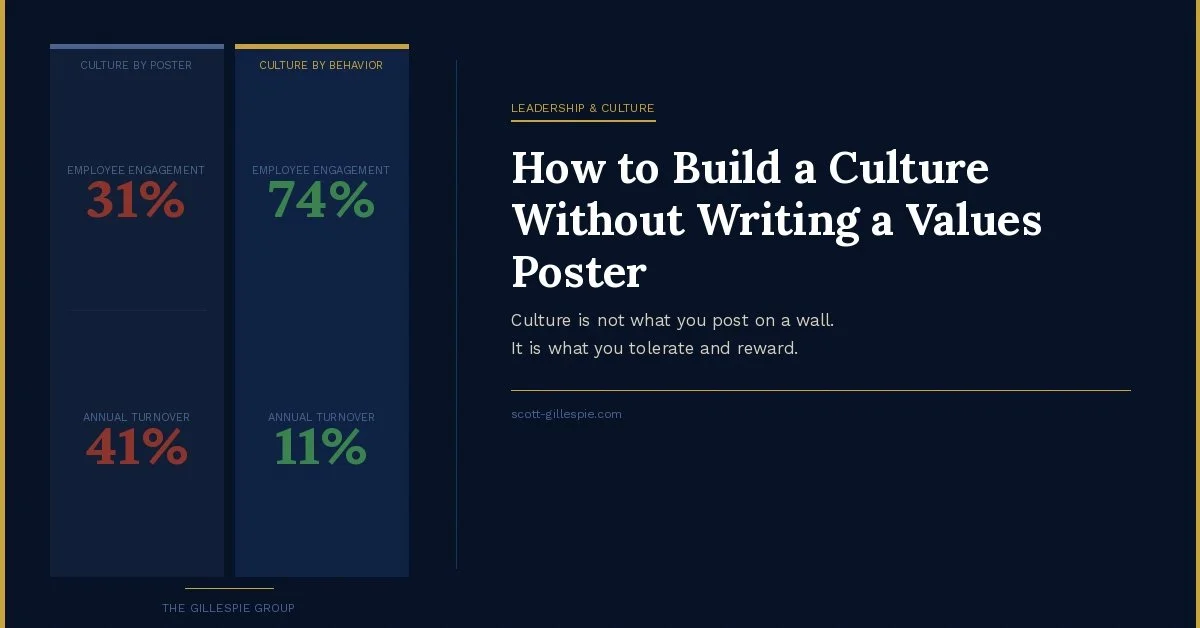
How to Build a Culture Without Writing a Values Poster
You likely have a set of words hanging on your office wall. Words like "Integrity," "Excellence," or "Teamwork" printed in a clean font over a stock photo of a mountain range. You spent a weekend retreat coming up with those words, and you felt a surge of pride when the framed posters arrived. But as you walk through your shop or sit in on a team meeting, you realize those words are invisible. Your best employees are frustrated by the lack of accountability, and your newest hires are picking up the lazy habits of the "C-players" you’ve allowed to linger. You realize that your values poster hasn't changed a single behavior. This is because culture is not a marketing slogan. Culture is the sum of what you reward, what you tolerate, and what you model when the pressure is on.
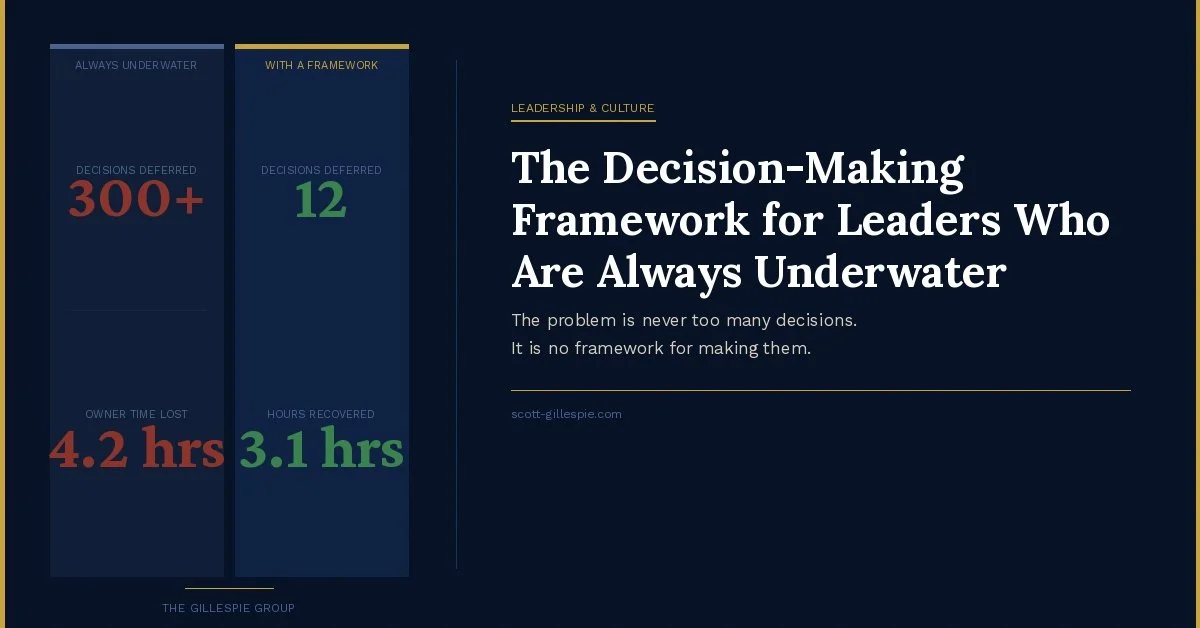
The Decision-Making Framework for Leaders Who Are Always Underwater
Your phone vibrates in your pocket for the fourteenth time since lunch. It is 2:14 PM, and every single one of those notifications represents a "quick question" from a team member, a vendor, or a client. You feel like you are gasping for air in a sea of trivialities. You built this business to gain freedom, yet you have become the central clearinghouse for every minor crisis within a ten-mile radius. You are underwater. You tell yourself that this is just the "cost of growth," but the truth is more uncomfortable. You are drowning because you lack a system for choosing what matters. You are treating every choice like a life-or-death struggle, and your brain is simply running out of fuel.