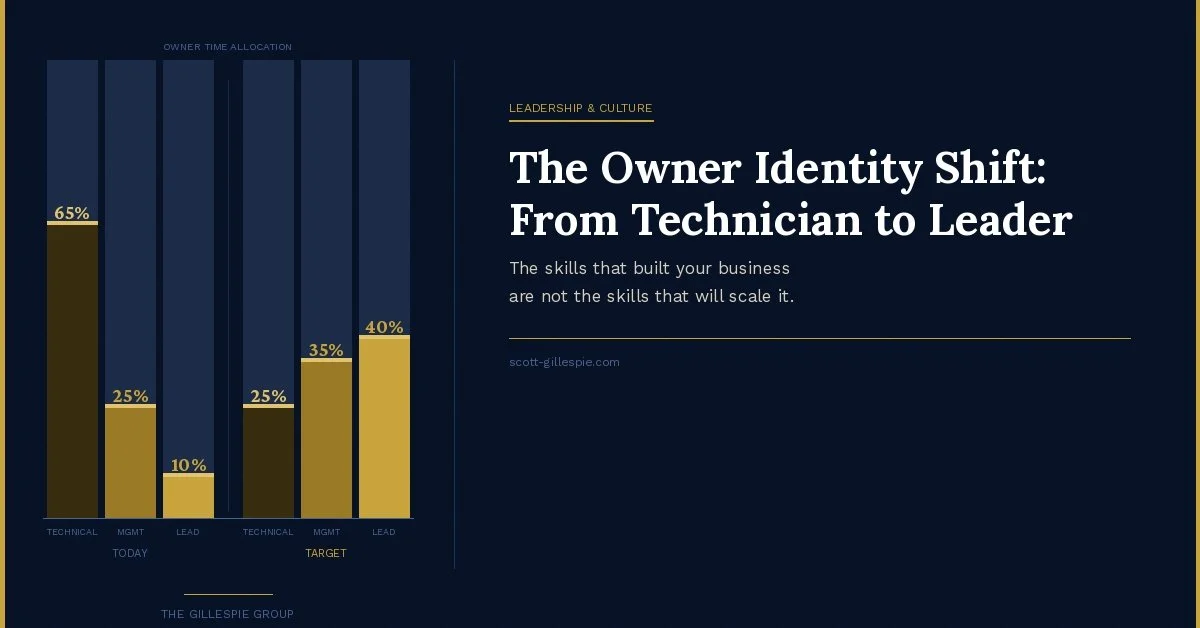
The Owner Identity Shift: From Technician to Leader
Jamie built her landscaping company with her hands. She knew soil composition, plant hardiness zones, drainage grades, and how to price a hardscaping job down to the last ton of stone. She was better at the technical work than anyone she ever hired. That competence was the business for the first four years — it drove the quality reputation that filled her calendar, earned the referrals, and funded the payroll.
By year five, she had eleven employees. And she was still on a crew three days a week.
Not because she had to be. Because she didn't know how not to be. The technical work was where she felt capable, confident, and useful. The leadership work — building the team, running the numbers, making the compensation decisions, having the accountability conversations — felt slippery. Uncertain. Like a role she wasn't sure she'd earned the right to play.
So she kept doing the work. And the business stayed exactly the size it was.
The pattern Jamie was trapped inside has a name. Michael Gerber mapped it in the 1980s, and three decades of research on small business growth has reinforced it consistently: most businesses plateau not because they hit a market ceiling, but because the owner never shifted roles. The skills that built the business — technical expertise, hands-on quality control, personal production — are not the skills that scale it. And the owners who can't make the shift don't fail. They just stop growing.
That shift is what this post addresses. The owner identity shift from technician to leader isn't a mindset seminar. It's a specific behavioral change, executed through a defined structure, over a deliberate timeline. Here's the framework.
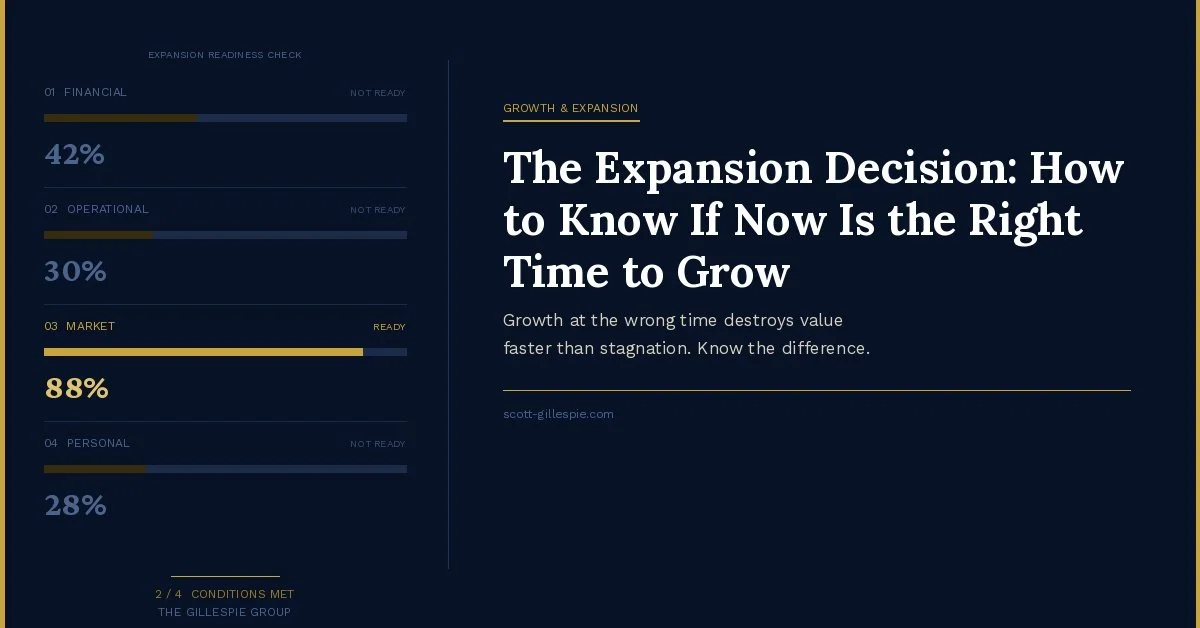
The Expansion Decision: How to Know If Now Is the Right Time to Grow
Chris ran a residential plumbing company in suburban Columbus. Five trucks, eight employees, about $1.4 million in revenue. He had more demand than he could service — calls he was turning away every week, a waiting list that stretched two weeks out, and a market that felt wide open. Every instinct he had said it was time to grow.
So he grew. Hired two technicians and a dispatcher. Leased a sixth truck. Rented a larger shop. Built out a basic office setup for the new dispatcher and invested in scheduling software he'd been putting off for two years. He was ready.
Fourteen months later, revenue had climbed to $1.7 million. His payroll had climbed to $890,000. His monthly debt service on the truck lease and shop build-out ran $8,400. His cash reserve — which had been sitting comfortably at $180,000 before the expansion — had dropped to $31,000. He lay awake on payroll weeks wondering whether the week's receivables would clear in time.
The business had grown. Chris felt like it was quietly killing him.
He hadn't made bad decisions. He had made good decisions at the wrong time, without a framework for knowing whether the conditions for expansion were actually met. The market signal was real. The demand was real. But the financial and operational foundation beneath that demand wasn't ready to carry the weight of what he built on top of it.
The business expansion decision is one of the highest-stakes choices a service business owner makes. Growth at the wrong time destroys value faster than stagnation. Stagnation at the wrong time lets a competitor fill the market you should have captured. Neither outcome is acceptable. What's needed is a framework that separates the excitement of the opportunity from the discipline of the readiness assessment.
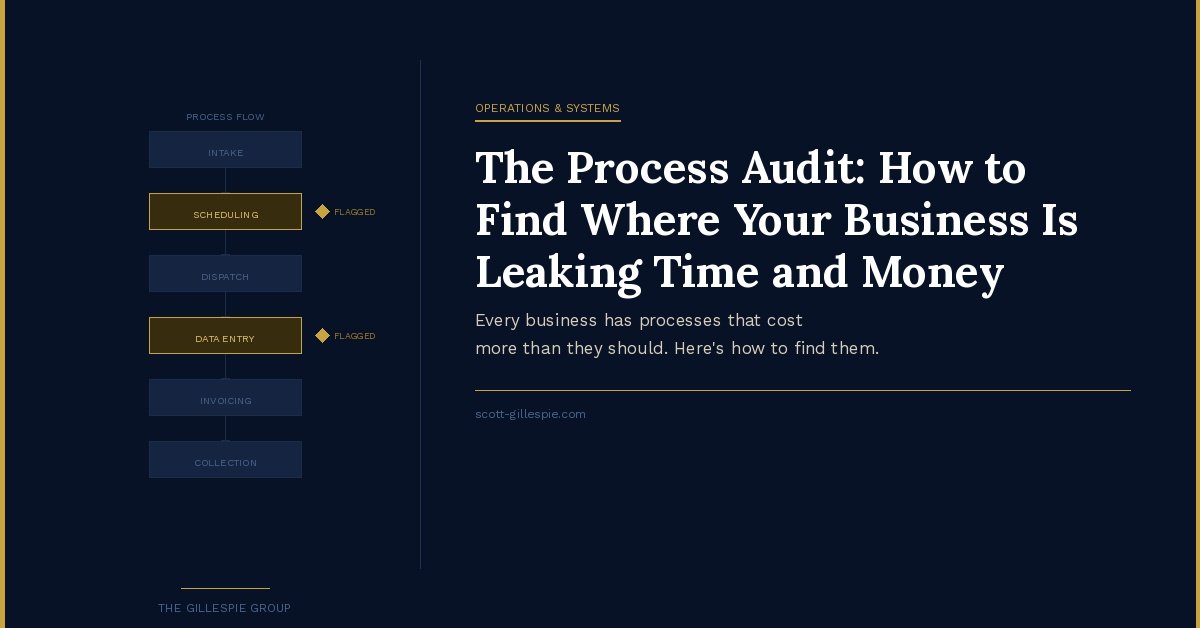
The Process Audit: How to Find Where Your Business Is Leaking Time and Money
Derek ran a seven-person HVAC service company outside Charlotte. Busy every single week — six technicians, a full dispatch calendar, and a reputation that kept the phone ringing. He worked 55 hours most weeks. His team worked hard. Revenue hovered around $1.1 million for three consecutive years without moving.
He wasn't losing customers. He wasn't underpriced. His team wasn't disengaged. The business just seemed to absorb every hour he poured into it and produce the same result. Busier than ever. Exactly the same size.
When someone finally asked Derek to walk through how a job moved from phone call to completed invoice, he described seven handoffs, three separate spreadsheets, two apps that didn't talk to each other, and a step where his office manager re-entered the same customer information into two different systems every single time. He had never counted the steps. He had just lived inside them for so long that they felt like the business — not friction the business happened to be carrying.
That friction had a cost. He just hadn't looked at it yet.
A process audit is the act of looking. It doesn't require a consultant or a technology investment or a weekend retreat. It requires a deliberate walk through every operational sequence in your business — asking at each step: does this create value, or does it simply consume time and money that could go somewhere else?

The Compensation Structure That Keeps Your Best People Without Bleeding Cash
Veronica ran a residential cleaning company with twelve employees. She had been in business for seven years and had never once lost a night of sleep over her team. Then, in a single quarter, three of her best people left. Not because she underpaid them. Not because the work dried up. Because they didn't know where they stood.
One of them told her on her way out the door: "I didn't know if staying made sense. Nobody ever told me what the path looked like."
Veronica had twelve employees and twelve separate compensation agreements — each one a product of a different negotiation, a different moment, a different level of urgency. None of them connected to each other. None of them told an employee anything about what came next. She had built a payroll. She had not built a system.
That distinction is what this post addresses. Your employee compensation structure — the architecture that defines how your small business pays people, how it advances them, and what they can expect — is either a retention tool or a departure accelerator. There is very little in between.
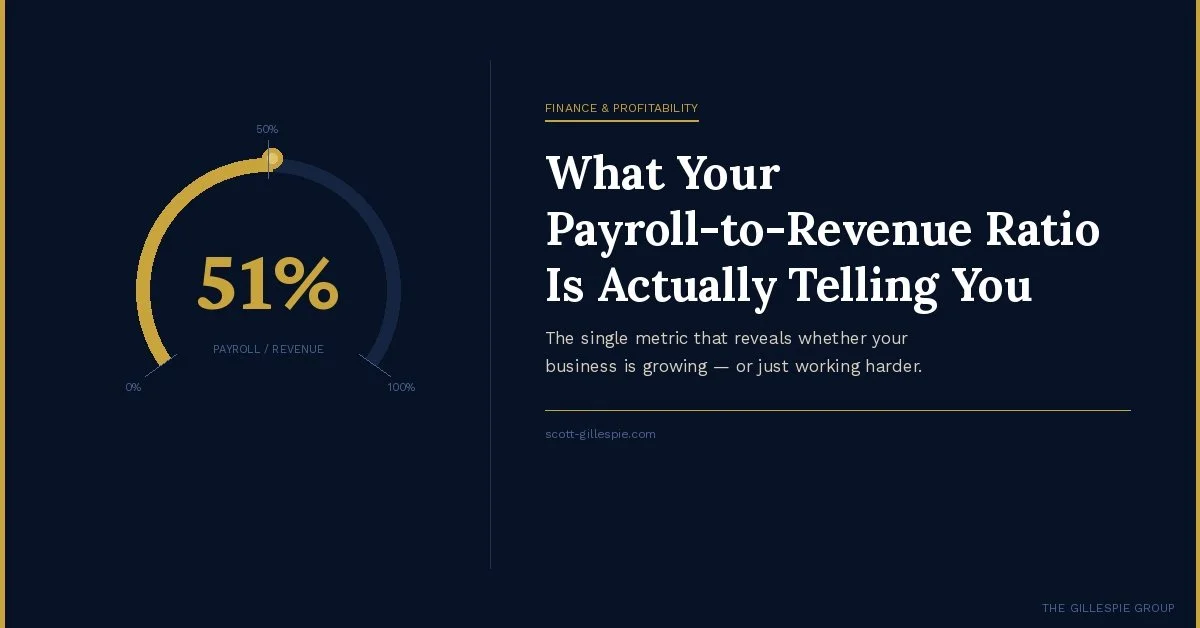
What Your Payroll-to-Revenue Ratio Is Actually Telling You
Marcus ran a commercial cleaning company out of Atlanta. Nine years in business, seven employees, three vans, and about forty commercial accounts. Revenue had climbed from $380,000 to just over $820,000 in four years. From the outside — and from where Marcus stood — the business looked healthy.
Then someone asked him what his payroll-to-revenue ratio was.
He didn't know. Not because he was inattentive. He ran payroll every two weeks and tracked the totals. But he had never calculated the ratio — never looked at what his labor investment represented as a percentage of the revenue it was supposed to generate. He was watching the dollar amount. He had stopped reading what the dollar amount meant.
When he finally ran the number, it was 51%.
That single figure explained everything: the months when revenue looked fine but cash felt strained, the raises that seemed affordable at the time but never improved the margin, the persistent feeling that the business worked harder than it grew. The payroll-to-revenue ratio had been sending a signal for years. Nobody had told Marcus it was worth reading.
Your business is sending the same signal right now. Here's how to read it.