Why Open Door Policy Is the Least Effective Management Strategy
You sit in your office with the door propped wide open. You take immense pride in this physical arrangement. You constantly tell your staff that you operate with total transparency and that you care deeply about their daily struggles. A junior technician walks in, sits down uninvited, and spends fifteen minutes explaining a minor conflict with a local vendor. You stop analyzing your monthly profit and loss statement to listen. You offer a quick, definitive solution to the problem. The employee thanks you enthusiastically, and they walk out. You feel like a highly engaged, empathetic boss. In reality, you just committed a profound act of gross managerial negligence.
The Feedback Conversation That Changes a Person's Performance Permanently
You pull an employee into your office. You sit them down to discuss a massive mistake they made on a job site yesterday. You feel nervous. You try to soften the blow by complimenting their punctuality before quickly mentioning the error, and then you frantically pivot back to praising their positive attitude. The employee leaves the room smiling. You feel relieved that the conversation avoided conflict. Two days later, the exact same operational mistake happens again. You feel a massive surge of anger. You assume the employee simply refuses to care. This assumption provides a comfortable excuse, but it masks a brutal failure in your own daily leadership. Your feedback failed completely because you prioritized your own emotional comfort over their professional clarity.
Why Your Team Reflects Your Leadership More Than Your Hiring
You review a stack of resumes. You conduct three rounds of interviews. You find the perfect candidate. You pay top dollar to secure their talent. You feel a massive sense of relief because you finally hired an absolute professional. Six months later, you watch this exact same individual show up late, cut corners on the job site, and deliver a completely mediocre result to your best client. You feel cheated. You blame the candidate. You blame the recruiter. You complain to your peers that nobody wants to work hard anymore. This comfortable lie protects your ego. The brutal truth cuts much deeper.
The Performance Review That Actually Changes Behavior
You sit across the desk from your employee. You hold a generic form you printed from the internet fifteen minutes ago. You nervously clear your throat and attempt to deliver a feedback sandwich. You offer a vague compliment, quickly mumble something about needing to improve communication, and then rush into another compliment to soften the blow. You end the meeting by granting a standard cost-of-living raise. The employee leaves the room completely confused about their actual standing in the company. Two weeks later, the exact same operational mistakes keep happening. You feel frustrated and assume you just hired unmotivated people. This assumption represents a massive failure in leadership.
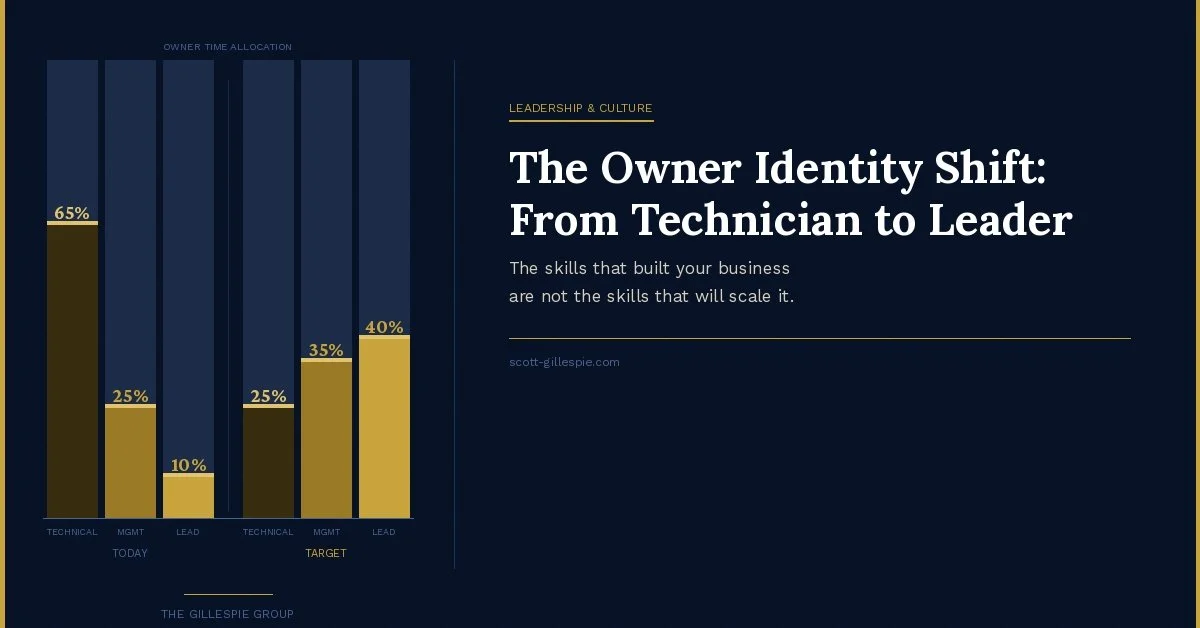
The Owner Identity Shift: From Technician to Leader
Jamie built her landscaping company with her hands. She knew soil composition, plant hardiness zones, drainage grades, and how to price a hardscaping job down to the last ton of stone. She was better at the technical work than anyone she ever hired. That competence was the business for the first four years — it drove the quality reputation that filled her calendar, earned the referrals, and funded the payroll.
By year five, she had eleven employees. And she was still on a crew three days a week.
Not because she had to be. Because she didn't know how not to be. The technical work was where she felt capable, confident, and useful. The leadership work — building the team, running the numbers, making the compensation decisions, having the accountability conversations — felt slippery. Uncertain. Like a role she wasn't sure she'd earned the right to play.
So she kept doing the work. And the business stayed exactly the size it was.
The pattern Jamie was trapped inside has a name. Michael Gerber mapped it in the 1980s, and three decades of research on small business growth has reinforced it consistently: most businesses plateau not because they hit a market ceiling, but because the owner never shifted roles. The skills that built the business — technical expertise, hands-on quality control, personal production — are not the skills that scale it. And the owners who can't make the shift don't fail. They just stop growing.
That shift is what this post addresses. The owner identity shift from technician to leader isn't a mindset seminar. It's a specific behavioral change, executed through a defined structure, over a deliberate timeline. Here's the framework.