How to Build a Referral System That Generates Predictable Revenue
You finish a massive project for a demanding client. You execute the work flawlessly. The client shakes your hand, smiles broadly, and tells you that your team exceeded every single expectation. You feel a massive surge of pride. You look the client in the eye and casually mention that they should tell their friends about your company. The client nods enthusiastically. You walk to your truck believing you just secured future business. You drive away and wait for the phone to ring. You wait for weeks. The phone remains completely silent. You assume the client simply forgot, or you assume their peers do not need your services right now. You dismiss the silence as bad luck.
The Customer Journey Map That Reveals Where You Are Losing Money
You spend thousands of dollars on marketing campaigns every single month. Your sales team grinds the phones to secure new appointments. You celebrate loudly when a massive contract finally closes. You assume the hard work ends the moment the client signs the dotted line. This assumption creates a fatal operational blind spot. The moment the contract signs, the real test of your enterprise begins. Every single interaction your client experiences after the sale either builds profound loyalty or silently erodes your profit margin. You must construct a rigid customer journey map small business revenue leaks hide inside to expose exactly where your cash vanishes into thin air.
The EBITDA Framework: The Number That Drives Most Business Valuations
You pour your blood, sweat, and emotional energy into your service business every single day. You check the bank account in the morning and feel a sudden surge of pride when the cash balance looks healthy. You boast about top-line revenue at local networking events and assume your growing sales figures prove your ultimate success. But when a sophisticated acquirer looks at your company, they completely ignore the vanity of your top line. They strip away your ego and search ruthlessly for one specific, clinical metric. They look for your EBITDA. If you lack a firm grasp of the EBITDA calculation small business valuation framework, you operate completely blind to the actual market value of your life's work.
The Geographic Expansion Framework for Service Businesses
You dominate your current territory. You look at the map and see the neighboring county. You assume that placing a pin on that new map represents the logical next step in your entrepreneurial journey. You feel the thrill of empire-building. You believe that your current success guarantees future victories in a new zip code. This arrogant assumption completely destroys profitable service companies. Opening a new territory does not simply mean driving your trucks a little further down the highway. It means launching a brand-new business from scratch. You must utilize a rigorous geographic expansion service business small business framework before you sign a new lease or hire a remote manager.
Why Most Owners Overpay in Taxes and the Framework to Fix It
You sit at your desk in the middle of April. You hold a pen over a checkbook, and your stomach drops. You write out a number that represents a massive portion of your life's work. You sign the check and hand it to the government. You feel a profound sense of resentment. You worked eighty hours a week all year. You navigated supply chain disasters, managed difficult employees, and dealt with demanding clients. You fought for every single dollar of revenue, only to watch a terrifying percentage of your cash vanish in a single afternoon. You view this payment as a non-negotiable penalty for your success. You accept it as a fixed cost of doing business.
The Three Types of Business Buyers and What Each Values Most
You pour your absolute lifeblood into your enterprise. You sacrifice your evenings, endure massive financial stress, and navigate endless operational disasters to build a company that generates real revenue. Eventually, the timeline shifts. You decide you want to step away. You assume that putting your business on the market resembles selling a house. You clean up the financials, apply a fresh coat of metaphorical paint, and wait for the highest bidder to arrive. You believe that every potential acquirer looks at your profit and loss statement and sees the exact same value.
Why Your Team Reflects Your Leadership More Than Your Hiring
You review a stack of resumes. You conduct three rounds of interviews. You find the perfect candidate. You pay top dollar to secure their talent. You feel a massive sense of relief because you finally hired an absolute professional. Six months later, you watch this exact same individual show up late, cut corners on the job site, and deliver a completely mediocre result to your best client. You feel cheated. You blame the candidate. You blame the recruiter. You complain to your peers that nobody wants to work hard anymore. This comfortable lie protects your ego. The brutal truth cuts much deeper.
When Acquisition Makes More Sense Than Organic Growth
You stare at your whiteboard every single morning. Your sales numbers inch upward month after month, but the progress feels agonizingly slow. You grind out every new client contract through sheer force of will. You spend thousands of dollars on digital marketing campaigns that yield mediocre, unpredictable results. You interview endless candidates trying to find one decent technician to put in an empty service truck. The slow crawl of this traditional growth path exhausts you. You feel like you push a massive boulder up a steep hill every single day. You assume this grueling effort represents the only valid way to build a ten-million-dollar company. This assumption blinds you to a massive strategic shortcut. Sometimes the absolute fastest way to acquire market share involves buying the competitor struggling right across town.
How to Run a Business Meeting That Actually Moves Things Forward
You sit at the head of the conference table. Five of your highest-paid employees stare back at you. You spend forty-five minutes talking about improving communication. People share random anecdotes. They complain about late vendor deliveries. They argue over the quality of the new breakroom coffee. You feel like a democratic leader because you gave everyone a voice. Then the clock hits the hour mark. Everyone stands up to leave. You suddenly realize nothing actually happened. No one took ownership of a new deadline. No one made a firm decision. Your technicians are now an hour behind on their revenue-producing routes. You just paid a massive tax on your own profit. You must redesign your gatherings before your calendar becomes the graveyard of your growth.
How to Evaluate a Business Partnership Opportunity Before You Agree
The prospect of a new partnership feels like a sudden burst of oxygen when you struggle to scale your service business alone. A competitor suggests a merger or a vendor proposes a joint venture. You immediately imagine the combined revenue. You envision a world where you handle the technical execution while they tackle the complex sales pipeline. You feel the absolute thrill of joining forces and ending the painful isolation of the lone founder. This emotional high marks the exact moment you become most vulnerable to a catastrophic strategic error. Most business partnerships fail terribly. They fail because the owners lack a clinical business partnership evaluation small business framework before they sign the binding paperwork.
The Technology Audit: What Tools Are You Paying for That No One Uses
You sign up for another software subscription. You watch the slick promotional video and convince yourself this new dashboard will finally organize your chaotic dispatch schedule. You plug in the company credit card. Six months later, you look at your bank statement. You realize your team still uses group text messages and physical whiteboards to manage the day. That shiny new software sits completely abandoned. You currently pay a monthly premium for a digital graveyard. This software bloat quietly drains your margins and complicates your entire operation.
The Real Cost of an Empty Seat — Run These Numbers
You finally reached the end of a profitable month. After you pay the technicians and the landlord and the tax collector, you see a surplus in your bank account. Most service-based business owners view this extra money as a reward. You feel a sudden urge to buy that new specialized truck. You want to upgrade the office furniture. You think about taking a larger draw to pay for a personal vacation. You believe you earned it.
The New Service Line Framework: How to Decide What to Add
A client asks if your team can handle a task slightly outside your normal scope. You feel that familiar rush of entrepreneurial excitement. You see an untapped revenue stream. You agree to the job without hesitation. You assume your technicians will figure out the logistics later. This impulsive decision feels like aggressive growth. It actually represents a dangerous lack of strategic discipline. Bolting a new service onto your existing operation without a clinical framework destroys your margins. It creates massive operational drag. It burns out your best employees. You must evaluate every new opportunity with ruthless objectivity.
Why Owner-Dependent Businesses Sell for Less and What to Do About It
You answer every emergency call. You sign every check. You close the biggest deals. You take pride in this relentless hustle. You believe your personal grit built this company from nothing, and you are entirely correct. But that exact same grit now actively destroys your future wealth. When you become the undisputed center of your business, you create a fatal operational flaw. You make the company completely unsellable. A buyer will not pay a premium for a high-stress job. They pay a premium for a wealth-generating machine. If your machine requires your constant physical presence to operate, the market will penalize you with a massive owner-dependency discount.
Why Organic Growth Is a Strategy, Not a Default
You describe your success to peers with a subtle sense of pride. You tell them you grew your business entirely through word of mouth. You never spend a dime on advertising. The phone simply rings because you deliver excellent service. You believe this accidental momentum validates your expertise. It feels good to be wanted by the market without having to ask. But treating organic growth as a default setting represents a massive tactical error. You surrender total control of your revenue to chance. You cannot predict your cash flow. You cannot plan your hiring schedule. You operate entirely at the mercy of the market. Organic growth must stop acting as a happy accident. You must turn it into a deliberate, engineered strategy.
The Capital Allocation Decision: Where to Put the Next Dollar You Earn
You finally reached the end of a profitable month. After you pay the technicians and the landlord and the tax collector, you see a surplus in your bank account. Most service-based business owners view this extra money as a reward. You feel a sudden urge to buy that new specialized truck. You want to upgrade the office furniture. You think about taking a larger draw to pay for a personal vacation. You believe you earned it.
But this impulsive approach represents a tactical error. This habit keeps your business stuck in a cycle of stagnant growth. Every dollar of profit is not a prize. It is a strategic asset. How you choose to deploy that next dollar determines your future. You will either remain a prisoner of your operations or become the architect of a ten-million-dollar enterprise.
Capital allocation serves as the most important skill an owner develops. You must move from a player-coach to a true leader. In the early days, you allocated your time to survive. As you scale, you must allocate your capital to thrive. If you lack a specific framework for this, the market will take that money back. It will disappear through inefficiency and missed opportunities. You must stop being a consumer of your profit. You must start being a clinical manager of your reinvestment. This requires a fundamental owner identity shift from technician to leader.
The Expense Approval System That Removes the Owner From Every Purchase
You act as the most expensive administrative assistant in your company. Every time a technician needs a new drill bit or the office manager wants to buy a ream of paper, they have to find you, explain the need, and wait for your verbal approval. You believe this keeps you in control of your cash flow. You tell yourself that you are protecting the margins and preventing waste. In reality, you are strangling your growth. You have turned yourself into the ultimate bottleneck. If you have to approve every twenty-dollar purchase, you are telegraphing that you do not trust your team or your own systems. This lack of trust represents a conscious choice to stay small.

How to Calculate What Your Business Is Worth Today
You currently treat your business like a black box. You know how much is in the checking account, you know what your revenue was last month, and you have a vague "gut feeling" that the whole thing is worth a few million dollars. You tell yourself that you’ll figure out the actual value when you’re ready to retire in ten years. This lack of clarity is a strategic mistake that limits your current decision-making. If you don't know your business's value, you cannot effectively allocate capital, you cannot negotiate with investors, and you certainly cannot perform a proper exit readiness assessment. To calculate business value small business owner today, you must move past emotional sweat equity and embrace the cold math of the market.
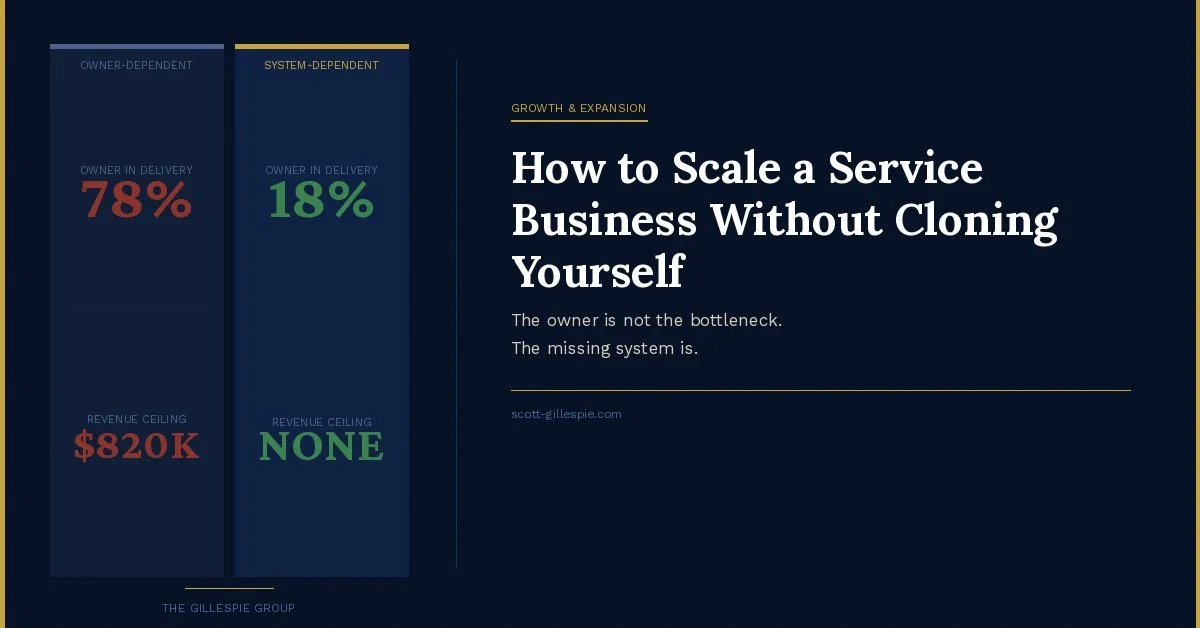
How to Scale a Service Business Without Cloning Yourself
You wake up every morning wishing there were two of you. You believe that if you could just find someone with your exact work ethic, your specific technical "magic," and your intuitive understanding of the client, all your growth problems would vanish. You spend your weekends scrolling through job boards, searching for a unicorn technician or a mini-version of yourself to take the load off your shoulders. This pursuit of a "clone" is a romanticized delusion that keeps your service business stuck in the mud. You cannot scale a personality. You can only scale a process.
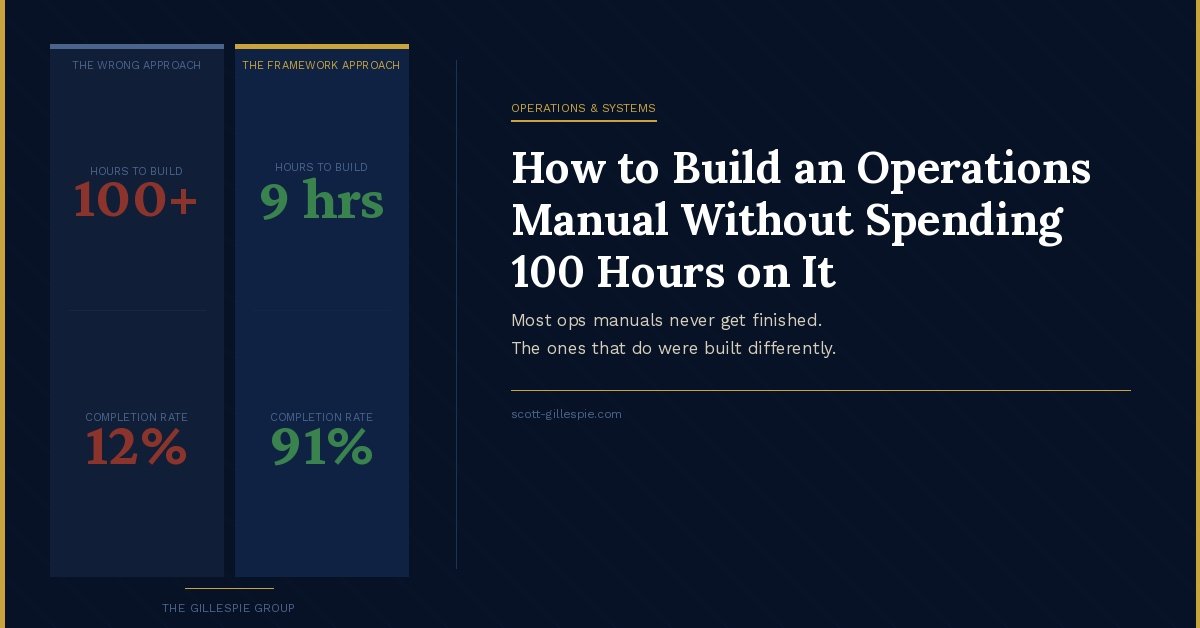
How to Build an Operations Manual Without Spending 100 Hours on It
You are the most expensive person in your building, yet you spend half your day acting like a biological Google search engine for your staff. Every time an employee knocks on your door to ask how to handle a specific client complaint or where to find the login for a vendor portal, your growth stops. You built this business on your personal expertise, but that expertise has now become your prison. You know you need an operations manual. You know you need documented systems. But every time you look at that blank Word document, you imagine a six-month project that involves hundreds of hours of typing and formatting. You decide you don't have the time, so you go back to putting out fires. This delay is a choice to stay small.