Why Open Door Policy Is the Least Effective Management Strategy
You sit in your office with the door propped wide open. You take immense pride in this physical arrangement. You constantly tell your staff that you operate with total transparency and that you care deeply about their daily struggles. A junior technician walks in, sits down uninvited, and spends fifteen minutes explaining a minor conflict with a local vendor. You stop analyzing your monthly profit and loss statement to listen. You offer a quick, definitive solution to the problem. The employee thanks you enthusiastically, and they walk out. You feel like a highly engaged, empathetic boss. In reality, you just committed a profound act of gross managerial negligence.
How to Handle Conflict Between Team Members Without Becoming the Referee
An employee knocks on your office door. They step inside, close the door behind them, and immediately launch into a bitter complaint about a fellow team member. They tell you that a senior technician spoke to them disrespectfully, or that the dispatcher assigned them an unfair route. You listen carefully. You feel a familiar, exhausting tension rise in your chest. You promise to look into the situation and handle it. They leave the room feeling validated, but you are now trapped. You just accepted the role of the company referee. You took their emotional burden and placed it squarely onto your own shoulders.
The Feedback Conversation That Changes a Person's Performance Permanently
You pull an employee into your office. You sit them down to discuss a massive mistake they made on a job site yesterday. You feel nervous. You try to soften the blow by complimenting their punctuality before quickly mentioning the error, and then you frantically pivot back to praising their positive attitude. The employee leaves the room smiling. You feel relieved that the conversation avoided conflict. Two days later, the exact same operational mistake happens again. You feel a massive surge of anger. You assume the employee simply refuses to care. This assumption provides a comfortable excuse, but it masks a brutal failure in your own daily leadership. Your feedback failed completely because you prioritized your own emotional comfort over their professional clarity.
How to Run a Business Meeting That Actually Moves Things Forward
You sit at the head of the conference table. Five of your highest-paid employees stare back at you. You spend forty-five minutes talking about improving communication. People share random anecdotes. They complain about late vendor deliveries. They argue over the quality of the new breakroom coffee. You feel like a democratic leader because you gave everyone a voice. Then the clock hits the hour mark. Everyone stands up to leave. You suddenly realize nothing actually happened. No one took ownership of a new deadline. No one made a firm decision. Your technicians are now an hour behind on their revenue-producing routes. You just paid a massive tax on your own profit. You must redesign your gatherings before your calendar becomes the graveyard of your growth.
Why Delegation Feels Like Loss of Control and How to Get Over It
You look at the email draft your newly promoted manager prepared and your chest immediately tightens. You see three minor formatting errors and a sentence that does not sound exactly like your personal voice. You delete the entire message and rewrite it yourself. You click send. You tell yourself that excellence requires a personal touch. You believe that nobody else cares as much as you do about the client experience. This belief creates a comfortable prison. You assume that doing the work guarantees the quality of the work. This specific mindset represents the ultimate delegation challenge small business owner control issue. You confuse micromanagement with high standards. You mistake your own physical exhaustion for dedicated leadership.
The Accountability System That Works in a Business of Any Size
Nagging is not leadership. It is a choice to stay small. You likely spend your afternoons repeating instructions you already gave three times this morning. You catch an employee making a mistake and you point it out with a heavy sigh. They apologize and they promise to do better. You feel like you are coaching them. You feel like a "hands-on" owner. But two weeks later the identical mistake happens again. This cycle is exhausting. It is the reason you feel like you are working harder but not growing faster. You are trapped in the "nagging cycle" because you have not built a system for accountability. You are trying to use your personality to keep the business together but personalities do not scale.
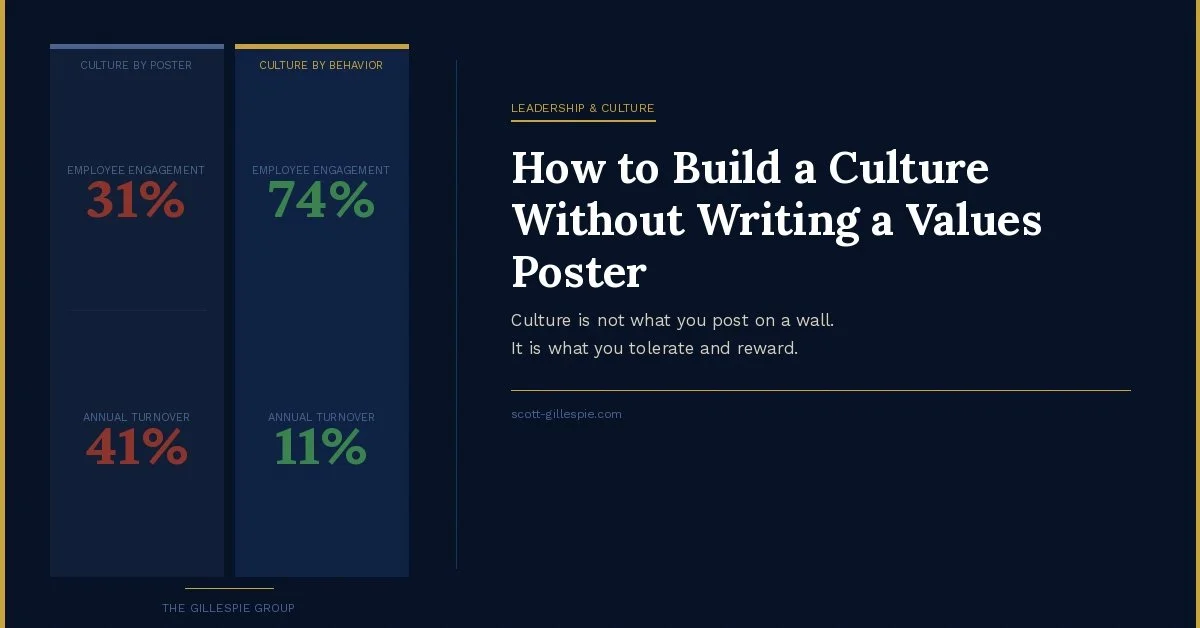
How to Build a Culture Without Writing a Values Poster
You likely have a set of words hanging on your office wall. Words like "Integrity," "Excellence," or "Teamwork" printed in a clean font over a stock photo of a mountain range. You spent a weekend retreat coming up with those words, and you felt a surge of pride when the framed posters arrived. But as you walk through your shop or sit in on a team meeting, you realize those words are invisible. Your best employees are frustrated by the lack of accountability, and your newest hires are picking up the lazy habits of the "C-players" you’ve allowed to linger. You realize that your values poster hasn't changed a single behavior. This is because culture is not a marketing slogan. Culture is the sum of what you reward, what you tolerate, and what you model when the pressure is on.
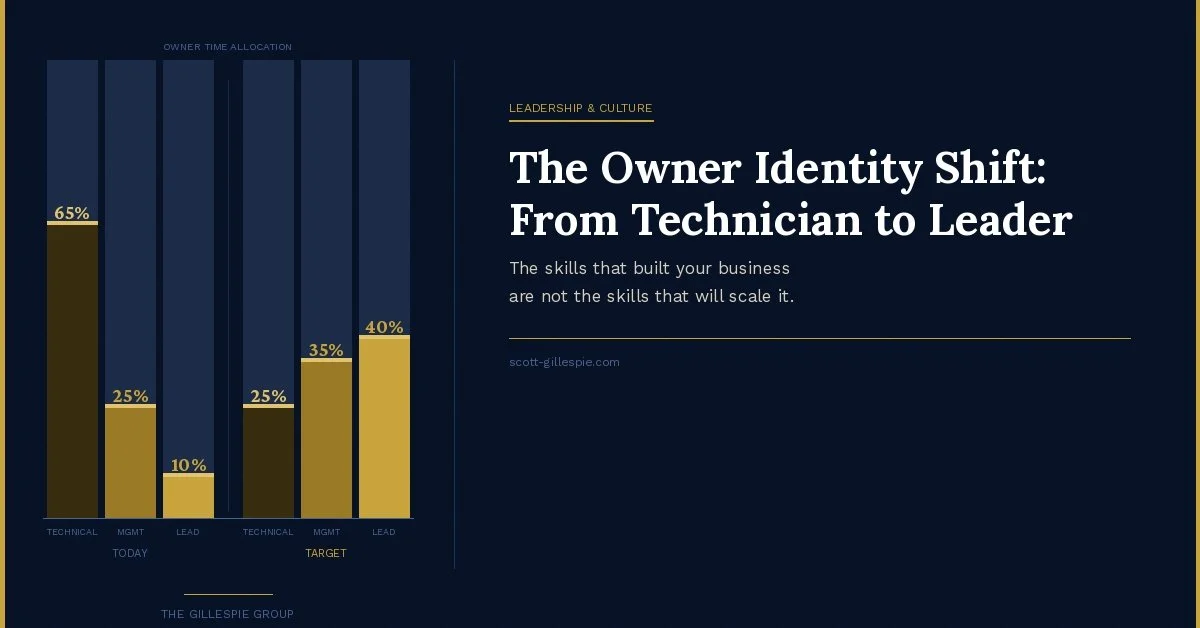
The Owner Identity Shift: From Technician to Leader
Jamie built her landscaping company with her hands. She knew soil composition, plant hardiness zones, drainage grades, and how to price a hardscaping job down to the last ton of stone. She was better at the technical work than anyone she ever hired. That competence was the business for the first four years — it drove the quality reputation that filled her calendar, earned the referrals, and funded the payroll.
By year five, she had eleven employees. And she was still on a crew three days a week.
Not because she had to be. Because she didn't know how not to be. The technical work was where she felt capable, confident, and useful. The leadership work — building the team, running the numbers, making the compensation decisions, having the accountability conversations — felt slippery. Uncertain. Like a role she wasn't sure she'd earned the right to play.
So she kept doing the work. And the business stayed exactly the size it was.
The pattern Jamie was trapped inside has a name. Michael Gerber mapped it in the 1980s, and three decades of research on small business growth has reinforced it consistently: most businesses plateau not because they hit a market ceiling, but because the owner never shifted roles. The skills that built the business — technical expertise, hands-on quality control, personal production — are not the skills that scale it. And the owners who can't make the shift don't fail. They just stop growing.
That shift is what this post addresses. The owner identity shift from technician to leader isn't a mindset seminar. It's a specific behavioral change, executed through a defined structure, over a deliberate timeline. Here's the framework.