How to Build a Referral System That Generates Predictable Revenue
You finish a massive project for a demanding client. You execute the work flawlessly. The client shakes your hand, smiles broadly, and tells you that your team exceeded every single expectation. You feel a massive surge of pride. You look the client in the eye and casually mention that they should tell their friends about your company. The client nods enthusiastically. You walk to your truck believing you just secured future business. You drive away and wait for the phone to ring. You wait for weeks. The phone remains completely silent. You assume the client simply forgot, or you assume their peers do not need your services right now. You dismiss the silence as bad luck.
The New Service Line Framework: How to Decide What to Add
A client asks if your team can handle a task slightly outside your normal scope. You feel that familiar rush of entrepreneurial excitement. You see an untapped revenue stream. You agree to the job without hesitation. You assume your technicians will figure out the logistics later. This impulsive decision feels like aggressive growth. It actually represents a dangerous lack of strategic discipline. Bolting a new service onto your existing operation without a clinical framework destroys your margins. It creates massive operational drag. It burns out your best employees. You must evaluate every new opportunity with ruthless objectivity.
Working Capital: The Number That Separates Growing Businesses from Stalled Ones
You just landed the biggest contract in your company's history. You hang up the phone and stare at your desk. You should feel a massive surge of adrenaline. You should jump out of your chair and celebrate the victory with your team. Instead, a cold knot forms in your stomach. You look at your bank balance and realize the terrifying operational truth. To execute this massive project, you must order thousands of dollars in materials tomorrow morning. You must pay your technicians for the next four weeks of intense labor. You must cover the extra fuel, the insurance premiums, and the staging costs. You must pay all these expenses long before the client ever cuts you a single check. You just became a victim of your own success.
How to Scale a Service Business Without Cloning Yourself
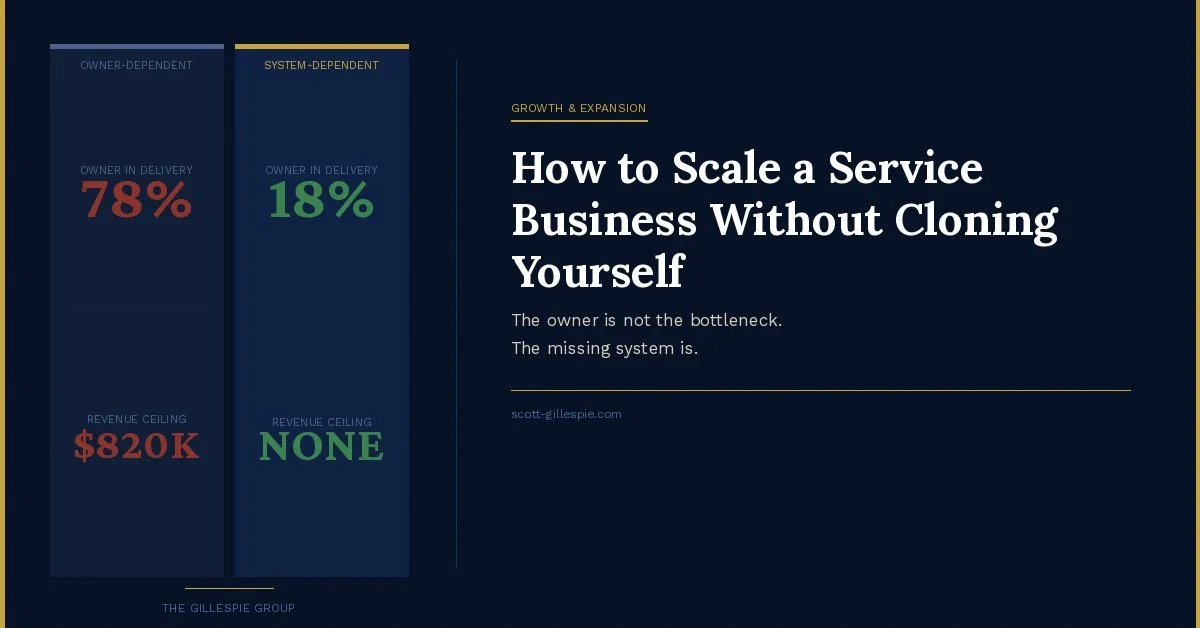
You wake up every morning wishing there were two of you. You believe that if you could just find someone with your exact work ethic, your specific technical "magic," and your intuitive understanding of the client, all your growth problems would vanish. You spend your weekends scrolling through job boards, searching for a unicorn technician or a mini-version of yourself to take the load off your shoulders. This pursuit of a "clone" is a romanticized delusion that keeps your service business stuck in the mud. You cannot scale a personality. You can only scale a process.
The Owner Identity Shift: From Technician to Leader
Jamie built her landscaping company with her hands. She knew soil composition, plant hardiness zones, drainage grades, and how to price a hardscaping job down to the last ton of stone. She was better at the technical work than anyone she ever hired. That competence was the business for the first four years — it drove the quality reputation that filled her calendar, earned the referrals, and funded the payroll.
By year five, she had eleven employees. And she was still on a crew three days a week.
Not because she had to be. Because she didn't know how not to be. The technical work was where she felt capable, confident, and useful. The leadership work — building the team, running the numbers, making the compensation decisions, having the accountability conversations — felt slippery. Uncertain. Like a role she wasn't sure she'd earned the right to play.
So she kept doing the work. And the business stayed exactly the size it was.
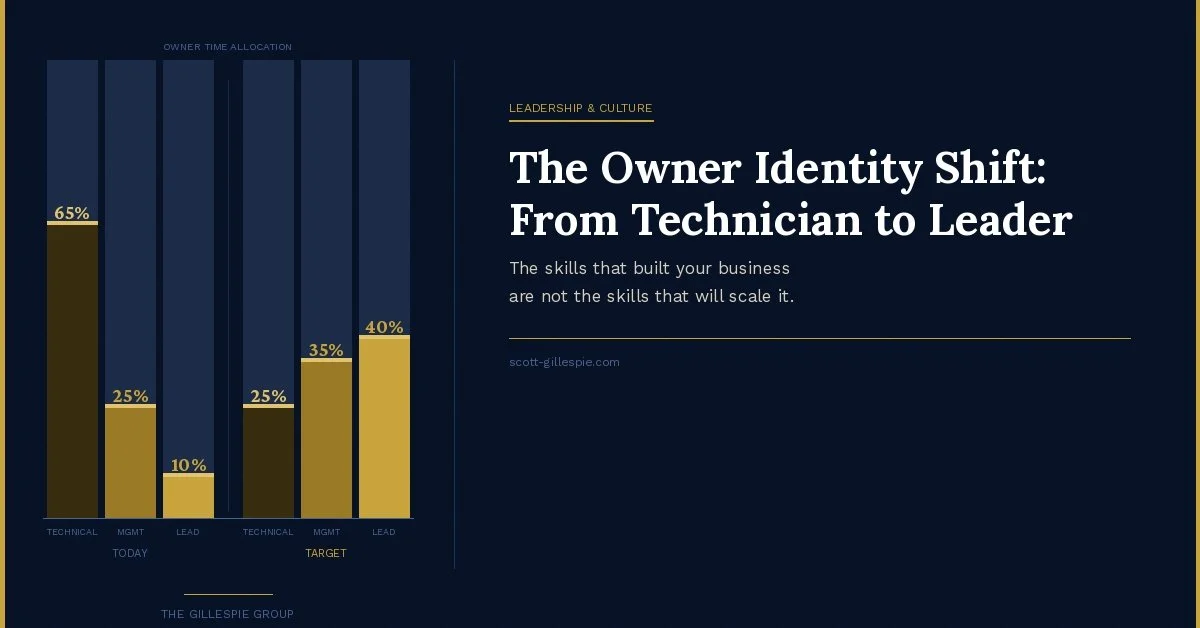
The pattern Jamie was trapped inside has a name. Michael Gerber mapped it in the 1980s, and three decades of research on small business growth has reinforced it consistently: most businesses plateau not because they hit a market ceiling, but because the owner never shifted roles. The skills that built the business — technical expertise, hands-on quality control, personal production — are not the skills that scale it. And the owners who can't make the shift don't fail. They just stop growing.
That shift is what this post addresses. The owner identity shift from technician to leader isn't a mindset seminar. It's a specific behavioral change, executed through a defined structure, over a deliberate timeline. Here's the framework.
The Expansion Decision: How to Know If Now Is the Right Time to Grow
Chris ran a residential plumbing company in suburban Columbus. Five trucks, eight employees, about $1.4 million in revenue. He had more demand than he could service — calls he was turning away every week, a waiting list that stretched two weeks out, and a market that felt wide open. Every instinct he had said it was time to grow.
So he grew. Hired two technicians and a dispatcher. Leased a sixth truck. Rented a larger shop. Built out a basic office setup for the new dispatcher and invested in scheduling software he'd been putting off for two years. He was ready.
Fourteen months later, revenue had climbed to $1.7 million. His payroll had climbed to $890,000. His monthly debt service on the truck lease and shop build-out ran $8,400. His cash reserve — which had been sitting comfortably at $180,000 before the expansion — had dropped to $31,000. He lay awake on payroll weeks wondering whether the week's receivables would clear in time.
The business had grown. Chris felt like it was quietly killing him.
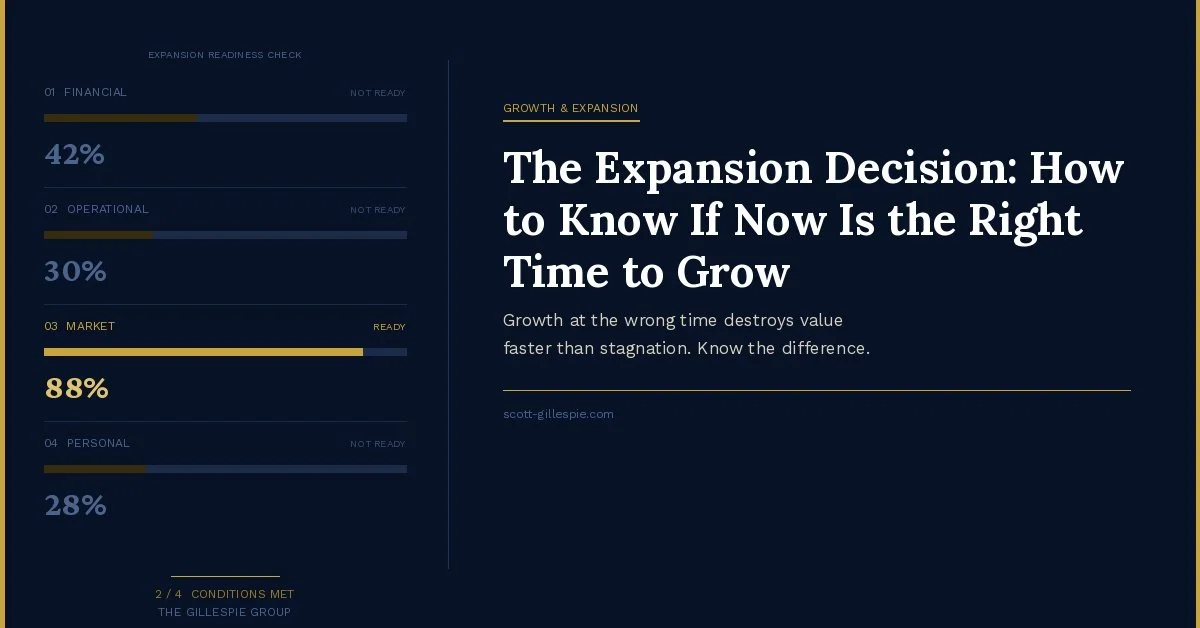
He hadn't made bad decisions. He had made good decisions at the wrong time, without a framework for knowing whether the conditions for expansion were actually met. The market signal was real. The demand was real. But the financial and operational foundation beneath that demand wasn't ready to carry the weight of what he built on top of it.
The business expansion decision is one of the highest-stakes choices a service business owner makes. Growth at the wrong time destroys value faster than stagnation. Stagnation at the wrong time lets a competitor fill the market you should have captured. Neither outcome is acceptable. What's needed is a framework that separates the excitement of the opportunity from the discipline of the readiness assessment.