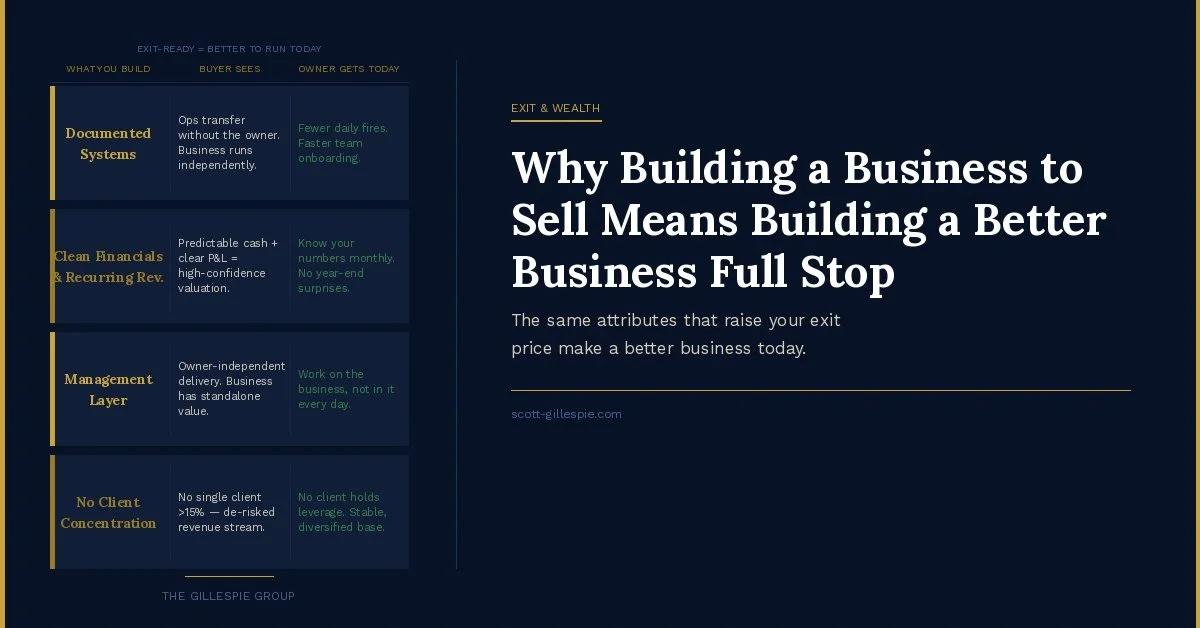
Why Building a Business to Sell Means Building a Better Business Full Stop
You likely tell yourself that you aren’t interested in selling. You built this company from the ground up, and you plan to run it until the day you decide to retire. You view "exit planning" as something for the future—a distant event that doesn't require your attention today. This perspective is a strategic mistake that limits your current revenue and tethers you to a business that cannot function without your constant input. The truth is simple: the disciplines required to make a business attractive to a buyer are the exact same disciplines that make a business profitable and peaceful for the owner to keep. When you build a business to sell, you inadvertently build a better business, full stop.
The most valuable asset in any service-based company isn't the equipment, the office lease, or even the client list. It is the ability of the business to produce a predictable result without the owner’s physical presence. Most small businesses under $10 million in revenue suffer from extreme owner-dependency. You are the lead salesperson, the chief problem solver, and the final word on every technical detail. While this makes you feel important, it makes the business worthless to an outsider. A buyer isn't looking to purchase a job; they are looking to purchase a cash-flow machine. If the machine breaks the moment you walk away, the machine has no value.
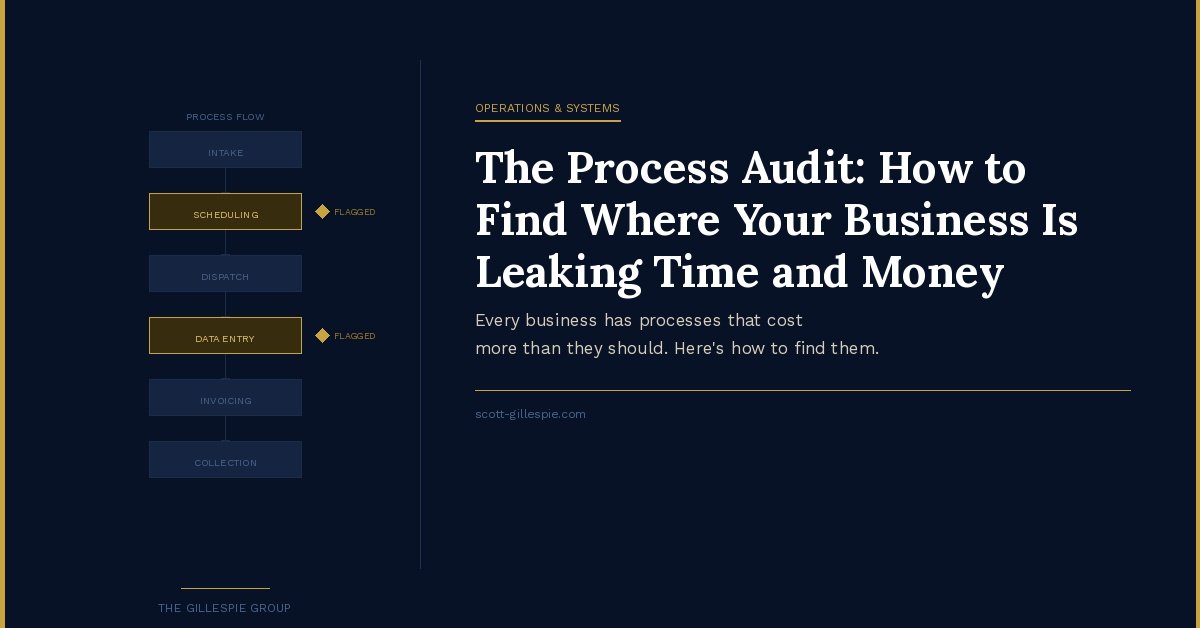
The Process Audit: How to Find Where Your Business Is Leaking Time and Money
Derek ran a seven-person HVAC service company outside Charlotte. Busy every single week — six technicians, a full dispatch calendar, and a reputation that kept the phone ringing. He worked 55 hours most weeks. His team worked hard. Revenue hovered around $1.1 million for three consecutive years without moving.
He wasn't losing customers. He wasn't underpriced. His team wasn't disengaged. The business just seemed to absorb every hour he poured into it and produce the same result. Busier than ever. Exactly the same size.
When someone finally asked Derek to walk through how a job moved from phone call to completed invoice, he described seven handoffs, three separate spreadsheets, two apps that didn't talk to each other, and a step where his office manager re-entered the same customer information into two different systems every single time. He had never counted the steps. He had just lived inside them for so long that they felt like the business — not friction the business happened to be carrying.
That friction had a cost. He just hadn't looked at it yet.
A process audit is the act of looking. It doesn't require a consultant or a technology investment or a weekend retreat. It requires a deliberate walk through every operational sequence in your business — asking at each step: does this create value, or does it simply consume time and money that could go somewhere else?