Why Standardization Is a Competitive Advantage, Not a Constraint
Service-based business founders often view operational standardization as a bureaucratic nightmare. Many entrepreneurs launch their companies precisely to escape rigid corporate rules. They take massive pride in delivering highly customized, bespoke solutions to every single client. They believe this unique, artisanal approach represents their ultimate value proposition in a crowded, competitive market. This romanticized mindset creates a devastating operational ceiling. Treating every single client interaction like a unique work of art guarantees severe fatigue across the entire staff. Customization destroys scalability entirely. When an enterprise attempts to reinvent the wheel on every dispatch, the operation inevitably drowns in chaos. Embracing a business standardization competitive advantage small business leaders rely upon provides the only true path to operational freedom. Standardization does not stifle creativity or ruin the culture. It eliminates the exhausting friction of daily guesswork and unleashes unprecedented profitability.
The Customer Journey Map That Reveals Where You Are Losing Money
You spend thousands of dollars on marketing campaigns every single month. Your sales team grinds the phones to secure new appointments. You celebrate loudly when a massive contract finally closes. You assume the hard work ends the moment the client signs the dotted line. This assumption creates a fatal operational blind spot. The moment the contract signs, the real test of your enterprise begins. Every single interaction your client experiences after the sale either builds profound loyalty or silently erodes your profit margin. You must construct a rigid customer journey map small business revenue leaks hide inside to expose exactly where your cash vanishes into thin air.
What SOPs Are and Why Every Business Over Five People Needs Them
When your business employed three people, you managed the operation through sheer proximity. You watched every task. You heard every client phone call. You corrected mistakes the moment they happened. You acted as the human operating system for the entire company. Now you employ more than five people, and the cracks in that foundation appear everywhere. You find yourself repeating the identical instructions five times a week. Your technicians deliver widely inconsistent results to your clients. The rework eats your margins. You feel the business slipping through your fingers, and your only solution involves working more hours to watch everyone closer. This reaction traps you in a cage of your own making.
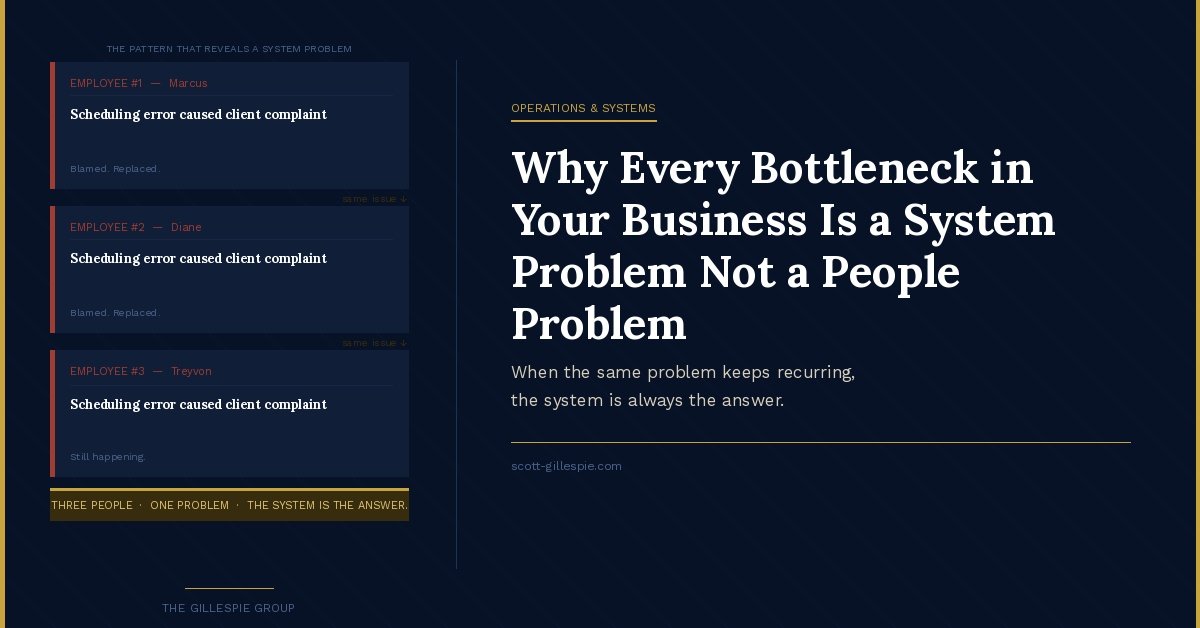
Why Every Bottleneck in Your Business Is a System Problem Not a People Problem
Three months after Kyle promoted his best field tech to service manager, he was ready to move her back. Calls from the field were still landing on his phone. Jobs were going out late. Clients were complaining about things that had nothing to do with the quality of the work. Kyle's new service manager looked overwhelmed, disorganized, and — frankly — not ready for the role.
He had been two days from having a very uncomfortable conversation with her when someone asked him a different question: what exactly had she been given to manage the job with?
Kyle thought about it. She had been given the title. She had been given the authority to direct the field crews. She had been given access to the dispatch calendar and the client files. What she had not been given was a documented escalation process for client complaints, a defined threshold for which field decisions she could make independently versus which ones required his sign-off, a standard for how jobs were supposed to be sequenced and dispatched when two high-priority requests landed on the same morning, or a single written procedure she could train the next person on if this ever needed to change.
She wasn't failing the system. She was operating without one. And Kyle was about to fire her for it.