When Acquisition Makes More Sense Than Organic Growth
You stare at your whiteboard every single morning. Your sales numbers inch upward month after month, but the progress feels agonizingly slow. You grind out every new client contract through sheer force of will. You spend thousands of dollars on digital marketing campaigns that yield mediocre, unpredictable results. You interview endless candidates trying to find one decent technician to put in an empty service truck. The slow crawl of this traditional growth path exhausts you. You feel like you push a massive boulder up a steep hill every single day. You assume this grueling effort represents the only valid way to build a ten-million-dollar company. This assumption blinds you to a massive strategic shortcut. Sometimes the absolute fastest way to acquire market share involves buying the competitor struggling right across town.
The Real Cost of an Empty Seat — Run These Numbers
You finally reached the end of a profitable month. After you pay the technicians and the landlord and the tax collector, you see a surplus in your bank account. Most service-based business owners view this extra money as a reward. You feel a sudden urge to buy that new specialized truck. You want to upgrade the office furniture. You think about taking a larger draw to pay for a personal vacation. You believe you earned it.
The Capital Allocation Decision: Where to Put the Next Dollar You Earn
You finally reached the end of a profitable month. After you pay the technicians and the landlord and the tax collector, you see a surplus in your bank account. Most service-based business owners view this extra money as a reward. You feel a sudden urge to buy that new specialized truck. You want to upgrade the office furniture. You think about taking a larger draw to pay for a personal vacation. You believe you earned it.
But this impulsive approach represents a tactical error. This habit keeps your business stuck in a cycle of stagnant growth. Every dollar of profit is not a prize. It is a strategic asset. How you choose to deploy that next dollar determines your future. You will either remain a prisoner of your operations or become the architect of a ten-million-dollar enterprise.
Capital allocation serves as the most important skill an owner develops. You must move from a player-coach to a true leader. In the early days, you allocated your time to survive. As you scale, you must allocate your capital to thrive. If you lack a specific framework for this, the market will take that money back. It will disappear through inefficiency and missed opportunities. You must stop being a consumer of your profit. You must start being a clinical manager of your reinvestment. This requires a fundamental owner identity shift from technician to leader.
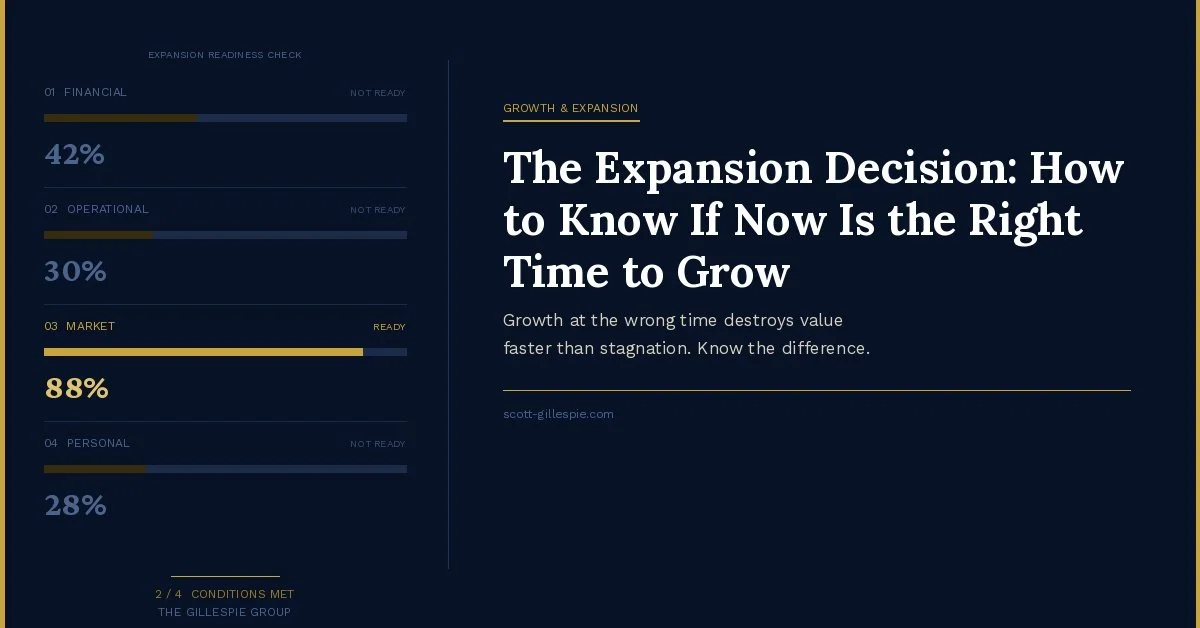
The Expansion Decision: How to Know If Now Is the Right Time to Grow
Chris ran a residential plumbing company in suburban Columbus. Five trucks, eight employees, about $1.4 million in revenue. He had more demand than he could service — calls he was turning away every week, a waiting list that stretched two weeks out, and a market that felt wide open. Every instinct he had said it was time to grow.
So he grew. Hired two technicians and a dispatcher. Leased a sixth truck. Rented a larger shop. Built out a basic office setup for the new dispatcher and invested in scheduling software he'd been putting off for two years. He was ready.
Fourteen months later, revenue had climbed to $1.7 million. His payroll had climbed to $890,000. His monthly debt service on the truck lease and shop build-out ran $8,400. His cash reserve — which had been sitting comfortably at $180,000 before the expansion — had dropped to $31,000. He lay awake on payroll weeks wondering whether the week's receivables would clear in time.
The business had grown. Chris felt like it was quietly killing him.
He hadn't made bad decisions. He had made good decisions at the wrong time, without a framework for knowing whether the conditions for expansion were actually met. The market signal was real. The demand was real. But the financial and operational foundation beneath that demand wasn't ready to carry the weight of what he built on top of it.
The business expansion decision is one of the highest-stakes choices a service business owner makes. Growth at the wrong time destroys value faster than stagnation. Stagnation at the wrong time lets a competitor fill the market you should have captured. Neither outcome is acceptable. What's needed is a framework that separates the excitement of the opportunity from the discipline of the readiness assessment.