How to Increase Business Value in 12 Months Without Major Capital Investment
You review your balance sheet and assume the only way to dramatically increase your company's value involves securing a massive line of credit. You believe that catching the eye of a sophisticated buyer requires buying out a local competitor, purchasing a sprawling new facility, or funding an expensive fleet of heavy trucks. You convince yourself that driving valuation upward demands an intense injection of outside capital. This widespread assumption paralyzes small business operators. You actively delay your exit planning because you feel you lack the cash reserves to scale the enterprise.
The Transfer of Value Framework: How to Move Knowledge Out of Your Head Into the Business
You hold every single operational secret inside your head. You know the exact quirk of your oldest client and precisely how to navigate the complex software integration that crashes every Tuesday. You possess the unique ability to calm down your most volatile vendor before they cut off your supply line. You take profound pride in this expertise. You believe this deep, specialized knowledge makes you the absolute most valuable asset in your company. You operate under a massive delusion. This specific knowledge, trapped exclusively in your brain, represents the single greatest liability to your future wealth. If your business requires your memory to function, your business holds absolutely no value to anyone but you.
The Transfer of Value Framework: How to Move Knowledge Out of Your Head Into the Business
You hold every single operational secret inside your head. You know the exact quirk of your oldest client. You understand precisely how to navigate the complex software integration that crashes every Tuesday. You possess the unique ability to calm down your most volatile vendor. You take profound pride in this expertise. You believe this deep, specialized knowledge makes you the most valuable asset in your company. You are entirely wrong. This specific knowledge trapped exclusively in your brain represents the single greatest liability to your future wealth. If your business requires your memory to function, your business holds absolutely no value to anyone but you.
Why Owner-Dependent Businesses Sell for Less and What to Do About It
You answer every emergency call. You sign every check. You close the biggest deals. You take pride in this relentless hustle. You believe your personal grit built this company from nothing, and you are entirely correct. But that exact same grit now actively destroys your future wealth. When you become the undisputed center of your business, you create a fatal operational flaw. You make the company completely unsellable. A buyer will not pay a premium for a high-stress job. They pay a premium for a wealth-generating machine. If your machine requires your constant physical presence to operate, the market will penalize you with a massive owner-dependency discount.
The Buyer's Perspective: What Acquirers Actually Look For
You look at your business and see decades of memories. You see the late nights, the missed family dinners, and the technical hurdles you fought to overcome. You see the sheer grit it took to build your revenue from nothing. You believe this emotional equity adds value. A buyer does not. A potential acquirer looks at your business and sees a product. They see a series of future cash flows. They see risk. If you want to command a premium price for your life's work, you must change your perspective. You must view your operation through the cold, calculating lens of an investor.
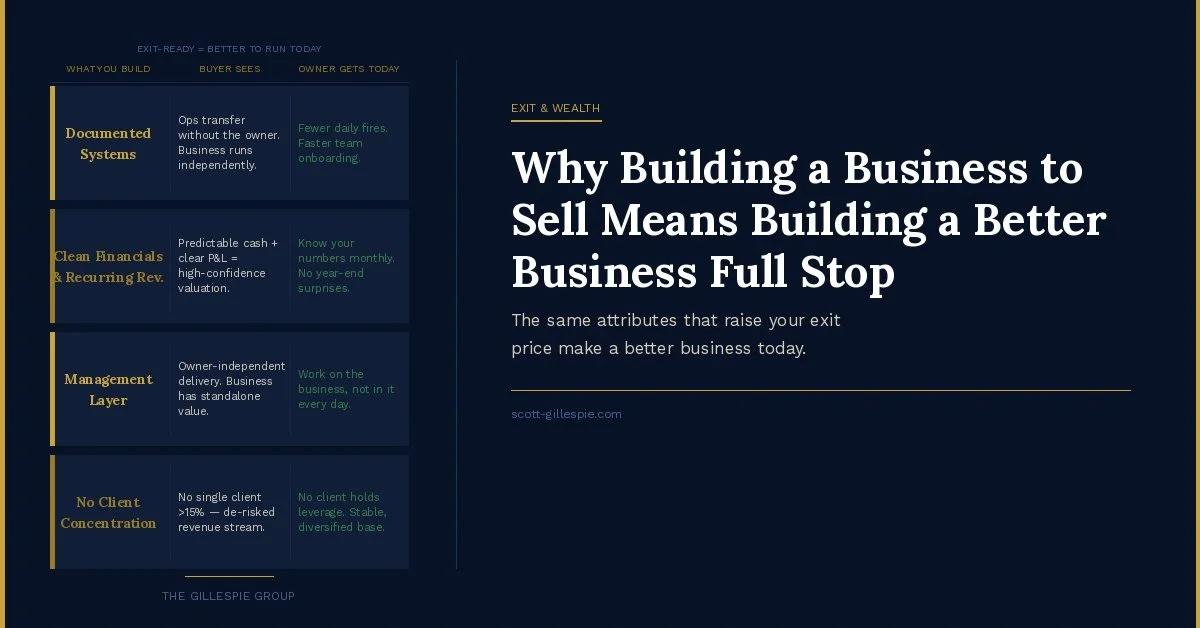
Why Building a Business to Sell Means Building a Better Business Full Stop
You likely tell yourself that you aren’t interested in selling. You built this company from the ground up, and you plan to run it until the day you decide to retire. You view "exit planning" as something for the future—a distant event that doesn't require your attention today. This perspective is a strategic mistake that limits your current revenue and tethers you to a business that cannot function without your constant input. The truth is simple: the disciplines required to make a business attractive to a buyer are the exact same disciplines that make a business profitable and peaceful for the owner to keep. When you build a business to sell, you inadvertently build a better business, full stop.
The most valuable asset in any service-based company isn't the equipment, the office lease, or even the client list. It is the ability of the business to produce a predictable result without the owner’s physical presence. Most small businesses under $10 million in revenue suffer from extreme owner-dependency. You are the lead salesperson, the chief problem solver, and the final word on every technical detail. While this makes you feel important, it makes the business worthless to an outsider. A buyer isn't looking to purchase a job; they are looking to purchase a cash-flow machine. If the machine breaks the moment you walk away, the machine has no value.